
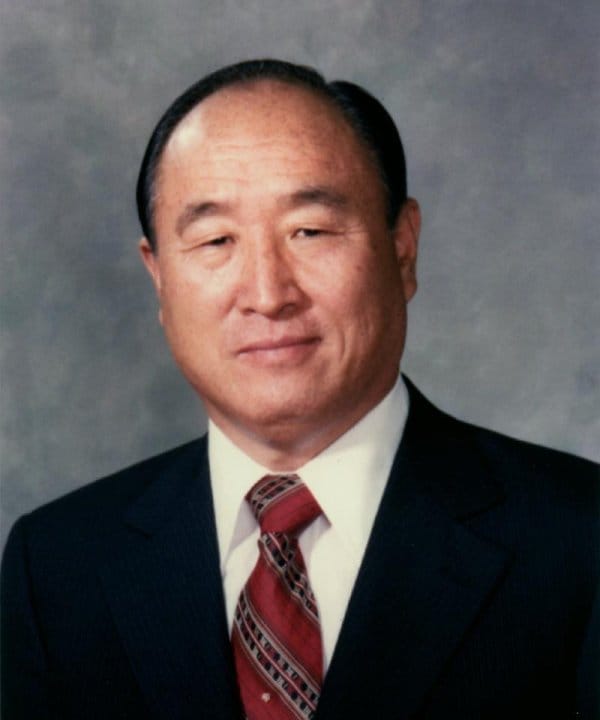
Cheon Jeong Gung, Gapyeong, Gyeonggi, Korea
Reverend Moon offers a bow.) “Where have you come from?” (From South Gyeongsang Province.) “Did you sleep in your cars, or stay somewhere overnight?” Elder Lee Yong-heum is expected to arrive tomorrow.
The New Era When the Last Can Stand First
At the beginning of the year, there are important international conferences to attend. When you consider Korea's regional roles, Gyeongsang Province has played the leading part until now, but in terms of the providence, Jeolla Province stands in Abel's position, and the peninsula as a whole cannot be brought to completion through Gyeongsang Province alone. North Korea regards Jeolla as a second homeland.
The April 3 Incident and the conflict around Mount Jiri introduced distortions into Korean history, and Gyeongsang's influence is bound up with this.
Among those who led the student movements at major universities, leaders at Seoul National University and Korea University were prominent, and there was an overall coordinator for that period. Marriage connections tie together Gyeongsang figures, Bo Hi Pak, and Hwang Sun-jo. Hwang Sun-jo belongs to the 6,000 Couples, which has become central, and the significance of the number six is worth weighing carefully.
I understand the principles of communism as well as anyone—better, even. That ideology demands absolute separation: when crossing the threshold, two cannot pass together, whether they are brothers, husband and wife, or parent and child. One must be eliminated. This is the essence of the left wing, and in their purges, they leave no one standing—they erase even the shadows of their enemies.
Korea's cultural traditions and customs are remarkable. Yet in South Korea, people seem confused about what actually constitutes left-wing versus right-wing thought. When they hear “right wing,” do they understand it as recognizing God as the Absolute? Communism is pure materialism; according to its labor theory of value, only human beings possess productive power, while machines contribute nothing.
But this is fundamentally mistaken. Modern production depends entirely on automated machinery, yet communist ideology insists that only human labor creates value. It is an obvious contradiction that cannot hold.
Loyalty, Filial Piety, and the Clarity of Distinctions
When I examine my family's place in traditional history and classical learning, I seek to understand why our lineage developed as it did, particularly given the contributions of my grandfather Moon Yun-guk, which the historical records preserve. He was buried in Jeongseon, a mountain valley in Gangwon Province, and when his grandfather appeared from the spiritual world to reveal the burial site, he wrote it down at once—the clarity of his mind was remarkable.
The reason someone in the spiritual realm can communicate with the earthly realm is that they embody the history of loyalty and filial piety, fulfilling the ideals of those virtues, which allows the connection to hold across both worlds.
Those who do not understand these principles act from hidden motives in the dark, doing as they please with the world. I do not work that way. I am clear about distinctions: left is left, right is right, and center is center. Most Christians do not even know who Reverend Moon is or where he comes from.
So the question turns to the direction Gyeongsang Province should take, and I am the one who must address it. The people in the intelligence services know that whenever Reverend Moon has faced difficulty, he has set the situation in order.
These days, the National Intelligence Service plays that role, and within it, there are few who do not know of Reverend Moon. Even among the people of Gyeongsang, some know of him—the kind of people gathered here as Ambassadors for Peace.
The Ambassadors for Peace are not confined to the ruling party, nor only to the Democratic Party. They transcend party lines. There are nearly fifty thousand of them, and the ranks of the opposition are woven in among them.
By proportion, those who worry for the nation are, in fact, more numerous. Yet such people cannot speak out. They cannot speak freely before the people of Gyeongsang, and they cannot speak freely before the people of Jeolla.
I am thinking about where those who kept silent from the time of Japanese colonial rule will now turn and how their relationship with the Unification Church will unfold.
The character 北 (north) has no obstruction and can flow in any direction, while 南 (south) has a pillar structure beneath it that grounds it in place—the visual structure of the characters reflects their conceptual meaning, with the sheep radical 羊 nestled within 南.
Among the provincial place names, there are Uiju and its “new” counterpart Sinuiju, and likewise Anju and Sinanju, showing how the prefix 신 (“new”) creates paired settlements.
Why do these divisions exist?
The biblical parallel of Cain and Abel suggests that the North-South division is as fundamental and tragic as that ancient separation.
Unity has broken down at every level — between father and son, between husband and wife, between brothers. On what foundation should that oneness rest? It rests on bloodline rather than on birth order.
There are Korean customs concerning birth order and family hierarchy. Second sons and second daughters tend to achieve success, while third daughters were traditionally married off without consulting their birth charts. Korean culture maintains strict distinctions of hierarchy: even a single day's difference in birth determines elder from younger, and with twins, whoever emerges first—by thirty or forty minutes—is definitively the elder brother, with no ambiguity allowed.
Physical differences such as height or weight are not relevant; only the day and hour of birth determine one's position. This is why fortune-telling through the Four Pillars must capture the year, month, day, and hour, each element holding a strict order in which year supersedes month, month supersedes day, and the hours are divided into twelve zodiac categories.
Conscience
Why do the directional orderings differ—east-west-south-north in one case, west-east-north-south in another? Who determined these conventions?
The conscience itself knows the correct order, so long as one has not strayed from it. Just as roots and seeds must all turn toward the west, this is the principle of heaven and earth.
The same applies to north and south: the northern and southern nations are now in conflict. All living creatures follow this pattern as well—like the swallows that fly south in autumn and return north in spring, following the seasonal rhythm of creation.
Consider the numerology beneath this pattern: the third day of the third month and the ninth day of the ninth month, where 9 × 9 makes 81—pointing to a deeper mathematical harmony in these cycles.
When the ninth day of the ninth month is named, it becomes the worst of numbers; in the Four Pillars or in the I Ching, identical numbers cancel one another, so nine and nine eliminate each other. And here is a puzzle: if nine times nine were to make ninety-one rather than eighty-one, then ninety-one would open the gate to one hundred—yet with two nines present, it does not.
In a Four Pillars reading, the year, month, day, and hour of birth are paired; the negative elements cancel among themselves, and the positive ones do the same, so that everything must be entirely reconstructed. Even identical twins, however alike in appearance, do not share the same destiny or fortune.
The difference in their birth times matters greatly—even thirty minutes apart yields distinct fortunes. One twin may inherit the descending fortune of the mother while the other receives the ascending fortune of the father, or they may resemble different siblings. These variations require that you account for all four directions: east, west, south, and north.
When was Heo Mun-do born—which month and which day by the lunar calendar?
Won-hyeong-i-jeong and the Order of Value
What, then, does won-hyeong-i-jeong (origination, flourishing, benefit, and firmness) truly mean?
It introduces the cardinal virtues of benevolence, righteousness, propriety, and wisdom, along with the Three Bonds and Five Relations that structure human life, all framed within the reality of a personal God.
Without intellect, emotion, and will — and without truth, goodness, and beauty — there is no foundation for value or meaning. Absolute value cannot stand on its own; value emerges only in relation to an absolute God. Theorists who deny this cannot explain their position when pressed.
There are front and rear manifestations, right and left manifestations. Without grasping all six directions—upper, lower, front, rear, right, and left—you cannot properly assess value.
However excellent the front may be, you cannot claim its superiority until you have established what the rear is; comparison is essential.
Consider the term inyeon (relational bonds), and how it connects to myeong (命, destiny/life), whose character joins the radical for person with elements representing mouth and command. Without myeong as a standard, there is no way to evaluate the value of saeng (life); you must understand the precondition below before you can speak of what is above.
God established this principle by making the lower realm a precondition before creating the upper, which is why destinies cannot all be the same.
A sequence of features—the eyes, the mouth, the nose, the forehead, and the hair—shows how, without a rational order of hierarchy and position, value cannot be properly assessed.
One cannot simply claim goodness without understanding this foundational structure. And the roles within a family follow the same logic: a father must protect his wife and children, rather than expecting protection from them.
The character 正 (rightness) contains all the essential proportions — the vertical and horizontal axes, the balance of up and down, of left and right. When the proportions are off, the form is distorted.
The character 十 represents this perfect ninety-degree intersection, and unless the balance is exact, everything falls out of alignment. With a single inch of heaven as the center, east, west, south, and north are divided, and so destiny too is divided.
Even with twins, if the moment of the first cry differs, the Four Pillars differ; in the end, the question is which moved first at the instant of conception—the sperm or the egg.
Just as we ask about the order of God and His children, or of sperm and egg, the same logic explains the relationship of the housewife and the seed-bearer, of the guardian and the egg. The seed-bearer must exist first to enter the house; the guardian must exist first to hold the offspring—a relationship of cause and effect.
The womb, then, is the foundational space, the palace where the seed can dwell; and there is wordplay around jagung (子宮, “son's palace”) that connects it to the biological reality of where conception occurs. The question keeps returning: which comes first—the vessel or what enters it?
Revelation and Peoplehood
Sperm and egg come into being together; the sperm enters and consumes the substance of the egg, as a maggot consumes flesh and marrow. Menstruation in women begins at fourteen—twice the number seven—and continues through the late teens. Which, then, is more precious—the sperm or the egg?
If the sperm is precious, then to squander it in youth becomes a grave transgression. Men often disregard the egg entirely.
(This passage and the two that follow address human physiology and sexuality in clinical terms.) Many people fashion and use artificial substitutes while suppressing their desires and living in isolation — and what does that signify?
To deny one's ancestors and one's lineage cannot simply be excused as acceptable in the present moment. (The passage uses vocabulary concerning unmarried youth and physical intimacy.)
The same argument extends to women—to widows living alone, in particular. (The passage continues with an anatomical explanation, describing the hymen and foreskin as biological structures and their function in sexual relations.)
When one tries to push forward with confidence against the law of the cosmos, the result is to be bound and constrained—neck, wrists, ankles, and waist—with no escape except through death, which alone severs all these bonds.
Carrying No Attachments to Bukmang Mountain
When you go to Bukmang Mountain, you carry no attachments; everything is severed in what amounts to an escape, a breaking free.
The forty-nine-day rite arises from this numerical pattern—seven times seven makes forty-nine—and the Korean people have developed this practice with remarkable sophistication.
Eight times eight makes sixty-four, which represents a relative state, and this connects to the breathing pattern: one exhales on “one,” then “two,” and each breath grows smaller as the count rises.
When you exhale completely on “one,” you are emptied, so you inhale automatically—but less air enters than was expelled. This creates the pattern of one-two, three-four, in which each cycle diminishes. This is why, when establishing the generation count, an odd number occupies the father's position, and the uncle takes that same paternal role.
Now consider Chinese characters and the Dongi people, and the distinction between even and odd numbers in this framework. The wordplay turns on usu, which carries several meanings—” even number” (偶數), “excellent student” (優秀), and “melancholy” (憂愁)—and I move among them. The character 優 (“excellent”) is composed of 亻(the person radical) plus 憂 (“worry”), suggesting that excellence requires the overcoming of worry.
Consider the character 夷 (i) and the Dongi people who created the Chinese characters. There is the character 秀 (“outstanding”), which breaks down as 禾 (“rice plant”) with 乃 beneath it. For “genius” (天才), 天 joins 二 (“two”) with 人 (“person”); and the character for “talent” (才) uses 十 (“ten”) with a stroke extending rightward—this rightward movement represents excellence reaching outward.
How does the right hand move, and what does that reveal about the construction of characters?
The hand does not come down in just any direction; it matters whether it goes one way or the other, for that determines whether you gain benefit (利) or suffer loss.
The character 又 (“again”) relates to this idea of the right hand's movement and how it symbolizes occupying the world of the left.
Then there is the character 愛 (“love”), constructed similarly—the initial stroke (丿), then the cover radical (冖), with the heart radical (心) at its center. This represents the three attributes grounded in God as the Four Position Foundation — the eyes, the nose, and the mouth working together.
Where there is a subject, the partner provides support; if the load is heavy, even a small prop wedged firmly can bear the weight. The difference between 八 (“eight”) and 人 (“person”) is that 八 has an opening that lets things escape, while 人 is closed and contained.
The character 人 must be written correctly, with precise proportions, the placement set at two-thirds rather than one-third to keep its balance. The woman, though smaller, acts as the prop that supports the larger man; without that support, the A-frame carrier with its heavy load would collapse. A woman's role as a prop extends in every direction, supporting the father and the children like branches reaching east, west, south, and north.
Which, then, is more precious—the woman or the man?
The word “precious” (貴) carries different meanings depending on how the character is written—whether the shell radical (貝) is included affects the substance and the hierarchy.
In the natural order, whichever has more substance becomes the center while the lesser follows; and this principle of heaven and earth was something people like me grasped intuitively.
The I Ching and the Two Who Stand Braced
Then there is the Thousand Character Classic, which opens with the four characters representing heaven, earth, darkness, and yellow (天地玄黃).
The text moves through its opening sequence toward the closing section on the pitch-pipe laws and harmonization — 律呂調陽.
The character 調, with its speech radical, surveys everything around it, connecting back to the structure of the I Ching, the Zhou Yi (周易), where the principles of small and large, above and below, are unified.
When these cosmic principles align correctly, the I Ching radiates light by fitting into all four directions. Adjusting the laws of heaven and earth creates this luminous structure, which in turn brings forth the cosmos itself—雲騰致雨, where clouds rise and generate rain.
The sun, the moon, and the stars all depend on this arrangement, represented by the characters for “star,” “constellation,” “arrangement,” and “spreading.” The four seasons follow this same pattern, winter coming and summer going in their eternal cycle.
Where there is no conflict, it embodies Yang together with the principle of change from the I Ching. The two forces cling to one another and radiate light, representing the poles of yin and yang.
So I asked my grandfather why the text begins with heaven and earth but moves on to the harmony of yin and yang.
When I learned about heaven and earth from my grandparents, I asked why two people stand braced in the middle—why they hold that tension between them.
They stand braced as body and mind, and here the conflict emerges, for the body does not obey the conscience but constantly resists its commands. This is the fundamental struggle I recognize.
The more profound insight is that absolute value cannot exist in isolation. God, as the Absolute Being, has no absolute value; He can exercise at will if there is no partner to relate to. Value arises only through a relationship with another; the partner is what determines worth.
So, if God is the masculine subject, what could be better than God?
The answer lies in complementarity: if one possesses what the other lacks, that union becomes something superior to either alone. If God is convex, then the concave partner completes what is missing.
This leads to the question of which comes first—the concave or the convex. The resolution is that, while God is the masculine subject, that very subjectivity rests upon a precondition: woman. The man could be formed that way only because the woman exists as the necessary foundation. The logic is complete and clean.
Lineage, Surnames, and the Bamboo
Who, then, can receive absolute value—the higher, rather than the ordinary?
There is a man named Yang Chang-shik, and when one asks who stands behind him, the answer is Jeong Seon-ho. Consider the character 鄭 (Jeong) and its parts.
The right town-radical (阝) represents 邑, meaning “town,” shaped like a bow to signify protection — so the surname Jeong embodies the state's sacrificial offerings, connecting it to Jeong Doryeong, the nation's prophesied savior.
Consider also the surname Park (朴), which joins the tree radical (木) with the divination symbol (卜).
Compare the grass radical with the bamboo radical: the character 篤 (“devout,” “sincere”) uses the bamboo radical (竹) because true bamboo endures through spring, summer, and autumn while ordinary trees shed their leaves—so it must be written with 竹 rather than the grass radical.
The bamboo emerges fully grown all at once, with all its joints and sheaths already formed, unlike grass, which grows gradually. There is a Korean proverb that habits formed at three last until eighty, and the bamboo shoot demonstrates this principle—it shoots up complete in a single burst, fully developed from the moment it appears.
Bamboo borne on horseback represents devotion and the power to traverse all three worlds upon four legs, embodying the thousand-year fidelity expressed in the pairing of pine and bamboo.
Why is the bamboo character chosen in particular?
The pine endures through every season, yet there is something distinct in how these two plants are paired and ordered. A pastor teaches concerning the bearing of children: women who spend four years in the church should go out and bear children as pastors would.
Using the figure of three times three making nine, he illustrates the multiplying of spiritual influence through offspring, then builds toward the idea of twelve as a complete number representing the owner, the leader.
He moves then into the metaphor of bamboo and pine. The true bamboo represents the center, without branches, while the pine represents the branches spreading outward.
Do cranes prefer to perch on pine or on bamboo? — a question that sets up a teaching about what is central versus what is peripheral. The male crane looks beyond the present season toward the future, contemplating the world his offspring will inhabit and passing that vision on to them.
The cranes seize control of the air itself, conducting their wedding ceremony amid lightning and all the phenomena of the clouds—the interplay of negative and positive charges giving rise to the myriad forms of weather.
When the negative charge is above, it reverses and disappears. This creates turmoil in heaven and earth — the crash and boom of thunder. That sound originates in the air itself, which, though softer than cotton, ignites with tremendous force when the charges meet, burning fiercely as they connect.
When an intense man and woman love one another, that same powerful thunder and lightning emerge. In such a world, even the cat cries out “meow, meow,” raising such a racket in spring that the whole neighborhood cannot sleep. The mice too, running above the papered ceiling, squeak endlessly—“squeak“, squeak, squeak”—and sleep becomes impossible.
If one can rejoice in love, would one not cry out?
That cry echoes from heaven's throne all the way down to the earthly king's palace, opening every eye. Everyone bows toward that direction, saying, “I will go too.”
When such harmony and unity unfold, how can someone ignorant of the world, who wishes only to live for himself, claim that he needs no harmony and embrace an absolute individualism? But those who cannot cry out, who emit no light, become like the withered clouds of autumn.
Living a Life Like a Dream
I do what God has commanded, even without fully understanding it. (The passage turns to several Korean terms for birds and predatory motion.)
The gireogi is a wild goose, the nanchuni a kind of falcon, and the saemae a sparrowhawk. There is a hierarchy of predators: ducks take fish, then take geese; then the nanchuni takes even the sparrowhawk, and there is a king among the sparrowhawks.
There is a reference to Chinese mythology and the granduncle who spoke of this nanchuni bird. The nanchuni hunts with such ferocity that it does not eat again for months, crunching its prey down to bare bone — and my explanations mirror that crisp, clean delivery.
The Korean terms capture the plumpness and roundness the bird takes on from its efficient feeding.
(The passage describes the intoxicating sweetness of bear's bile—how the bitterness turns into a lingering sweetness that does not travel down the throat but stays in the mouth.)
This addictive quality extends even to something as mundane as nasal mucus, illustrating how the nanchuni's touch creates an all-consuming desire to consume anything connected with it.
— I knew everything before death, and I tell God that He taught me to govern when I came here, so that I have in fact practiced and mastered it — making me first in practice even though He conceived it first, which places Him in a position to accept my word. And God responds that He wishes there were ten million sons capable of reaching such heights and demonstrating the full extent of His vision.
A sharp-edged temperament cannot be effective in diplomacy. (Here, someone is called out to sing: Miss Heo is mentioned, along with Munsu Mountain and the Ulsan Arirang folk song, and she is asked to perform it.)
The conversation turns to the tonal qualities of different songs and instruments, comparing how a Goryeo celadon vessel resonates when you blow into it—the depth and hollow space producing a particular kind of resonance. Someone wishes to sing “Holo Arirang” instead, though I do not prefer that version; two people singing Arirang together sound better.
Among the variations of Arirang, there is an independent song that captures loneliness and the melancholy of unrequited love. Someone is asked to sing “Sae Arirang,” and it turns out she is the wife of a district pastor; she is then invited to perform a sorrowful song that expresses her emotional depth.
There are observations about the appearance of Gyeongsang women, attributed to their seafood diet, with references to the Nakdong River and a song called “Free World of the Heart,” and the wife of the South Gyeongsang district pastor is introduced into the conversation.
A sharp-edged temperament cannot work effectively anywhere, least of all in diplomacy, so I matched you with partners who could balance it out. Then there is Yang Chang-shik's wife — even searching a thousand years, you could not find another woman like her, and her worth runs deep.
Even when she is furious and turns fierce, clawing and biting, she slips quietly into the bedding. The more afraid you are, the more she withdraws into herself, hiding away in the dark—she is that skillful at reading a situation. But here is the paradox: if you think you are holding her captive, she will say the house is unbearable and leave with her bundle.
The true answer is to treat such a woman like a queen, and then fine sons and daughters will grow up.
Was this daughter the eldest or the second?
There is one I tried to marry off at eighteen who seems discouraged now, though she says she is studying. But what is the point of studying well if that is all she does? — I catch myself getting carried away with this line of thought and joke that I am starting to sound like a fortune-teller, a reputation I have apparently earned.
Palman Gunggwol (Eighty-Thousand Palaces)
(The section name is a play on the grandchildren's names.) When I went to Yeosu, the matter of Admiral Yi Sun-sin's naval authority came to mind. I thought it would be impossible to build a middle and high school where these children could be educated in English. Because the eight million dollars risked being squandered, I committed everything to it; and now, with Cheongshim Middle and High School established, the distinguished families south of the Han River compete to send their children there.
However much they may wish to send them, the children can enter only by passing the examination with a perfect score. Cheongshim Middle and High School stands before Cheongpyeong Palace and behind the hospital, and people do not realize it is connected with the facilities of the Unification Church.
The school has become famous, yet not everyone can enter. The high school teachers have been instructed to build an elementary school, and within a few years, as university graduates emerge, elementary school teachers will emerge as well.
If they fail to establish the elementary school or the kindergarten, the principal says they will be driven out. Watch—within ten years it will come to pass.
When I named my grandchildren, I gave them the names Shin-pal, Shin-man, and Shin-gung, with the meaning of Palman Gunggwol (Eighty-Thousand Palaces); but since the palace character 闕 could not be applied, the character 俊 (jun, “outstanding,” “heroic”) was used in its place, creating names that reflect excellence and nobility rather than mere architectural grandeur.
I have established institutions—palaces and hospitals—and taught and implemented traditional Korean medical practices such as moxibustion and bloodletting. There is an anecdote about a Korean practitioner of bloodletting who married a Japanese woman and performed an experimental procedure on me in my old age. Who, then, would trust a person with such abilities? I have accomplished more than what those people could have built with their hospitals.
Consider the historical record of Kim Nam-su, a man known for his mastery of moxibustion and acupuncture across the whole body. His practice adapts to the seasons—spring, summer, autumn, and winter—with different needling techniques for each. Because he regularly bathes and swims in the warm waters of the south, his body remains vigorous and healthy even at ninety-six, with the strength of a far younger man. The exercise of swimming keeps all four limbs and the whole body in excellent condition.
When I pressed him on how this was possible, he shared secret knowledge of moxibustion, but I realized that even with eighty or ninety percent understanding of the subject, there is still much I do not know.
Later, he wished to demonstrate moxibustion before people from Unification Churches around the world, but I declined—I told him such a public setting was not appropriate for this kind of treatment. Instead, I invited him to my room the next morning so that we could do it privately, just the two of us.
Cho Jeong-sun was coming today because I had asked her to explain the Happy Health machine to everyone. It turned out that her younger sibling, Cho Dong-ho, had seventeen years of experience with moxibustion—something neither Cho Jeong-sun nor I had known.
When I asked him about it, he shared extensive knowledge, and it struck me how valuable it would have been had the Unification Church recognized this expertise earlier. Watching him break down the machine I created, from first principles, is impressive—he surpasses even the knowledge of people like Son Dae-o and Hyo-yul from the church and is certainly ahead of Yu Jeong-ok in understanding how it all works.
The core principle is that han must be resolved through the completion of one's portion of responsibility within the realm of liberation—the resolution of han (해원).
I have been teaching publicly that people must study this completion of liberation through the fulfillment of responsibility, and many are realizing that they may have believed in the Unification Church without truly understanding this foundation. Gwak Jeong-hwan grasped it too, but if even one element is wrong, the whole becomes false rather than genuine.
The Realm of Rest of the Parents of Heaven and Earth and the Cosmos
The original realm was called “the Realm of Peace and Rest of the Parents of Heaven and Earth and the Cosmos,” but the word “peace” had been omitted after “Cosmos,” leaving only “the Realm of Rest of the Parents of Heaven and Earth and the Cosmos.” This distinction matters, for it marks a shift in what is being described about liberation beginning from the original God and the True Parents.
The complete form should be 천지부모천주평화안식권 — the Realm of Peace and Rest of the Parents of Heaven and Earth and the Cosmos—with “peace” restored; that dropped element needs to be reincorporated into the proper designation.
What, then, is true liberation? What is absoluteness (절대성)? It is the unseen, unknowable nature (성품) of the central God.
Then there is the realm of true lineage (참핏줄권), where authority (권) becomes the key concept—distinguishing absolute nature from the authority that flows from it.
The teaching establishes three interconnected realms: the realm of absolute true love and the realm of absolute life, both grounded in the absoluteness of God's nature. Without this origin centered on the absolute God, all these concepts collapse into meaninglessness—and that is the revelation being emphasized.
What was missing in the teaching was the word “peace” after “God.” Everything is liberation—the very era of liberation. One enters the realm of true victory, true love, and true life, but whoever cannot accept himself within each passing moment will be made to disappear.
Happy Health
The Happy Health is a treatment device that creates happy health. I have a strong drive to research, and I have developed an electrotherapy device unlike anything in history. Through this work, the principles of electricity are being fundamentally overturned. While in Las Vegas, I discovered Cho Dong-ho, a man who—like an ancestor of Happy Health—holds a historic record; he had paved a great wide road.
As for the house we own in Las Vegas, when the Parents visited, people who came with them would approach me with their illnesses, and I was told I absolutely had to cure them.
One man claimed that, given time, there was no disease he could not heal. He explained that when men and women engage in sexual relations wrongly, they contract AIDS, and he insisted that even AIDS could be cured.
I had not, in fact, conducted all the experiments myself before claiming I had, but when I visited Las Vegas, I attempted treatment for the first time. I was concerned that if I claimed to have treated and cured people, rumors might spread that I was a swindler.
When True Mother, the daughters, and others tried the treatment, they were impressed with the results. From a young age, when one side of my body hurt, the other side would sense it—I learned to locate the moxibustion points on my own and to apply treatment without formal instruction, relying on my sensitivity. Now, at ninety, I feel compelled to document and share this knowledge before I go.
The device I created is called “Happy Health” — not a happy disease, but a machine that generates genuine wellness and can address any ailment. The name turns on a play on words: doeji (“it works out”) echoes Doeji, the Pyongan dialect term for China—so the device works so well that it could even win over the land of China.
How shall I explain this to the Busan cliques?
They will listen if they wish, or ignore it if they wish—but how can I make them understand? It is like trying to perform a shamanic exorcism.
The beggar-song singers raise all their noise and commotion, going “pu-pu-pu,” and when they arrive at a village, they announce themselves as the same beggar from last year, still alive and back again. When I take part in such performances, I go around watching them—and even position myself as their leader.
I have practiced tightrope walking, and I can cross obstacles alone that others cannot keep up with. The movement is rhythmic—you go “whoosh,” then “whoosh” again, bending your body to find your balance before shifting direction and crossing the point with the reverse motion.
One Who Cannot Taste His Food Cannot Trust His Health
Someone who does not taste his food properly cannot trust his health. (There follows a discussion about the Busan cliques and their monthly dues, with someone asking what will be served for lunch.)
The passage turns to wild animals—boars, hunted creatures—that die in the valleys as they wander and lose their strength. I use the coarse term ssang-geot for these “coarse fellows” and describe how I curse at them, leaving them to die in a different valley each time I come back.
This connects to the next image: an animal that crawled into a leaf-filled pit during the cold months of October or November, covered itself with leaves, and died there. I reflect on that moment—the animal dying while still trying to survive—as an example of the kind of experience I have witnessed and taken into myself.
A beggar was lying by the roadside whom I helped as a student, spending an entire year's tuition to treat and cure him. Reflecting on such acts of compassion, I find myself asking about debt and obligation—whether I owe something to the people of Busan or Changwon, or whether they owe me, given how much I have given and how often I have been there for them.
(True Father calls for Hoon Dok Hae to begin, asking who is present and requesting that someone share the gist of the chapters they have read—note that this is part of a report on producing a booklet for True Father's ninetieth-birthday celebration.)
Whoever has spoken in place of Hoon Dok Hae must also convey the content fully. These words are like a testament, meant to be left behind; for the circumstances of life change, and so the goals and meanings shift accordingly, even when one's age or outward conditions remain the same.
I read Pyeong Hwa Shin Gyeong again and again, opening it with my eyes closed and letting my finger guide where I read, then sharing the passages—which emphasize teaching people to understand, as a means toward unifying families and clans together. The Cheon Seong Gyeong is a text I have read through many times, and I can sense from the way people approach it whether they truly understand its depth.
Most people find reading the whole text unfamiliar or difficult, which suggests there is still much ground to cover on their spiritual journey. As food fully digests and flows through the body as blood and sweat, the next meal tastes all the more delicious when one is starving. I could keep explaining further, but time is limited, so I move on from the foreword of the compiled chapters and continue the Hoon Dok Hae reading from chapter four, “The Path of Life Centered on Love.” (He addresses his grandchild Shin-jun playfully, asking for applause and joking that the child has come to catch him. Kim Hyo-yul finishes reading chapter four with a prayer.)
Becoming a Responsible Person
The leaders from the business sectors at Muchangpo were trying to meet with Kook-jin, but they were called here early this morning instead. By the tenth day, all the central leaders must gather to finalize the year's plans and budget.
These five days are critical for the international conference, and they are far from routine matters. Those responsible for recording historic events will feel unprepared if they have not made both inner and outer preparations aligned with their calling.
“Attend that meeting, and see to it that there is no deficiency in fulfilling the responsibility of the calling entrusted to you. As we will hold such a gathering, let the prepared gather there together—the leaders, I mean.
Generally, those seated here in front can attend, and so they do attend; but henceforth they must also supplement everything that is lacking in their related departments and manage the direction, the conduct, of their responsibility.”
“I would ask that we select here those responsible for such inner and outer fields—leaders with no deficiency in managing and guiding—and that they attend together. Understood? (Yes.) Now then, let us finish. (I will offer a bow.) Wait. You said there are five brothers, did you not? (Yes.) Call all of those you can call today.”
When you say “Yeosu,” it is part of Suncheon, and you must understand that, within the religious realm, Yeosu and Suncheon stand ahead of Daegu and Busan.
I would draw out, from among the Cho clan of the southern coast, a central Cho figure—an important leader for South Jeolla Province—selecting the key leaders for that province from among the Cho clans nationwide.
Did that man come as well? (That younger brother arranged to come in the afternoon.) One of the brothers arrives in the afternoon, while another is out in the provinces—a man devoted to the Four Pillars and the I Ching, who does not answer his phone because he is absorbed in his studies and his work.
We are discussing how to mobilize these family members when they are needed for our collective efforts and planning to select respected figures from the clan going forward.
Moving through the different clans—the Parks and the Kwaks — we identify who is present and note the family connections, with Bo Hi Pak named as part of the Park clan. Hwang Sun-jo took over the leadership of the Family Party after Chairman Kwak stepped back to focus on other responsibilities, and Hwang now leads the party's efforts.
The discussion then turns to Hwang's connection with Yeosu and Suncheon, regions of historic significance as the birthplace and homeland of Admiral Yi Sun-sin — to gather the clan of loyal subjects and so resolve Admiral Yi Sun-sin's han.
All That Was Divided Must Be Reconnected
What comes after loyalty—is it the realm of saints and holy people?
And how does the Teacher's lineage relate to the sanctity of the holy son, as against the realm of the parents? Consider the key terms—blessing and generation count.
Those who have received the Blessing must be comprehensively selected and reorganized into generational lineages, as God's homeland and hometown clan, for as yet no restored generation count exists.
Compare Adam's generational structure—Adam as the first generation, followed by the second and the third—with the framework of the Unification Church, in which the True Parents stand as the first generation, followed by the second and the third.
(Here, a reference appears to Hun-mo, who tracks the Blessing records.) People who were missed in the genealogical counting must be handled with care. We are gathering those scattered ones and liberating them through Adam's lineage, establishing God's homeland and hometown—which the True Parents share — and then organizing this into eight stages centered on the True Parents' UN and on God as the King of Kings, advancing from the individual through the family, the tribe, the people, and the nation.
You must belong to a specific tribe within an organized tribal system centered on union, and this structure cannot be altered. The satanic world that has been excluded must never occupy a position of superiority; heaven must reign above it, which is why even a single person matters in building toward completeness.
Unification emerges through harmony. And Korea holds a unique position as the only nation with a comprehensive genealogical system—distinguished even from Israel or from Mormonism, despite their own genealogical traditions.
Harmony Must Precede Unification
This is not a synthesis but a thesis-antithesis-division. Communism falsely claims that the combining of opposing forces creates unity, which contradicts God's actual principle of division between thesis and antithesis.
Consider the relationship between harmony and unification: harmony must come first, as the foundation for true unification. When the leaders of North and South meet and join hands, they need that underlying harmony to move forward together.
Here is the paradox: opposition itself can be resolved if just one side turns around—yet the logic of thesis-antithesis-synthesis breaks down completely, because the two opposing forces cannot truly cross over or stand together before God. They cannot exist side by side—husband and wife, brothers, father, and son—without one of them fundamentally changing. The only way across is through elimination; the communists understand this through their practice of purges.
In the thesis-division-combination framework, communism's ideology demands absolute obedience and one-way submission because its theoretical system lacks any inherent logic for harmony or mutual synthesis.
The Mother is essential to saving communism from its self-destructive nature; without her, the ideology collapses into absolute leftist purges and people's tribunals that claim to represent the masses but in fact serve only power.
When you examine it closely, there is no greater absurdity than a system that asks whether the people or God holds judgment, yet answers neither question truthfully.
This is why they must kneel before me and acknowledge that bloodline and unity matter — that separation breaks the foundation.
If I prepare the final moment rightly, I can reshape reality itself: nations are transformed, directions reverse, day and night exchange places, and time itself becomes malleable, stretching beyond the usual twenty-four hours into thirty-two, or one hundred twenty-four, as needed. To defend such a world, I must embody absolute righteousness — what is called 正 (jeong), which is formed by placing a lid upon the character for “stopping,” creating a sealed, perfect state.
(They discuss when to hold the meeting after the meal—it is now 8:18, so they will eat until nine, and those who can attend will take part. This was a special gathering before the Muchangpo meeting, and they are now ready to proceed with understanding the plan.