
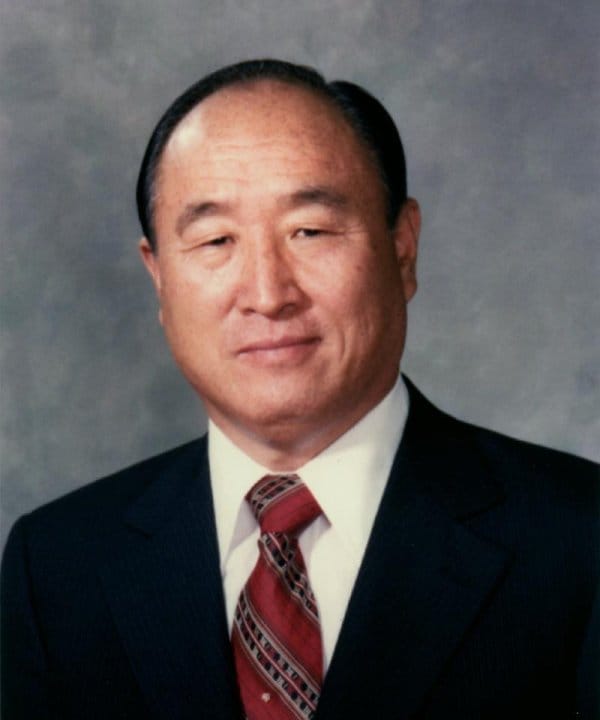
Former Headquarters Church.
When we compare our position at the time when, centering on the year 1960, we resolved and set out upon the seven-year course, with our present position now that we have passed through this six-year course, we can vividly see that an unimaginable change of environment has come about.
You will experience this well through your life of faith and through all the facts unfolding around you. And when we consider all the facts now unfolding across the whole nation, we cannot but come to recognize anew how weighty our mission is and how important a responsibility we bear.
You must also know that, after the first seven-year course ends, we must set out upon the second seven-year course.
What We Must Do During the Seven-Year Course
Every member of the Unification Church knows that, through this seven-year course our Unification Church has established, the grave question of whether we become loyal subjects before God and whether we become filial sons and filial daughters is decided.
“Filial child” and “loyal subject” are titles that cannot come forth from the same ordinary position as that of the multitude who live enjoying themselves. That is, in an ordinary environment, a true loyal subject and a true filial child cannot come forth; only in an extremely difficult and wretched environment can such a name shine greatly and remain in history. This is a fact we can know well by looking back over the history of days past.
In walking this seven-year course, all of you must seek only the road to your hometown, and you must attend to the parents of your hometown.
Moreover, as those who attend the parents of the hometown, you must build the nation of the hometown. It is beyond doubt that the seven-year course is the course we must walk while keenly feeling such a mission.
Because the human ancestors first fell, they lost the original nation, and they lost the true hometown that could not be trampled or violated even through ten million ages. This world of the hometown was trampled by Satan, and it is history that seeks to restore this world of the hometown.
We know that, in that course of history, our ancestors passed away amid the twists and turns of sorrow or amid wailing and despair.
When we who were born as the descendants of the fall, bearing this historical sorrow, look back over history, we cannot simply look upon this evil world of this age just as it is. As descendants who have carried on history, we must fulfill our responsibility.
Yet the question is: how far have we, members of the Unification Church, truly stood in the place of the history of days past and gone forth in the place of God from a position of taking responsibility for the age?
We cannot but examine such questions. Here we find ourselves at a stage where we must once again make, both inwardly and outwardly, a new resolve and a new vow.
When we ask whether the Unification Church you believe in, the Unification Church you know—or the church and the family members we call “our church” and “our family”—is now displaying well over one hundred percent of its value upon this earth, and whether it is truly such a name and such a position, God Himself cannot but hesitate to say so, and the Teacher himself cannot but hesitate as well.
You yourselves are also placed in a position where you cannot affirm that it is so. That is how things stand. Therefore, we must once more tighten our belts, remove all the bad conditions in our environment, gather our single-minded hearts, and make our resolve. Is this not the demand of the age and the work that we, who bear responsibility before these people, must do?
God’s Circumstance of Having to Raise the Unification Throng Once More
When we look back once more upon 1966, ten months have already passed. This year, we vowed before God and set out upon the four-stage doubling movement. I believe the goal we planned will be broken through without difficulty.
Some regional leaders and district leaders are overly confident about this, and there are even some who worry that the number of association members being gathered is too great; but this has come about not because you toiled and did well, but because we have entered an age in which it can be so.
Whenever I think that one might hold such thoughts, I cannot but worry over how great our toil of the past six years has been and over how far our labor has become a condition that can repay God. When I think of that, our toil up to now is nothing whatsoever.
When we see how, in the world, an individual who has fallen into ruin overnight cannot rebuild and recover even over ten years or over a whole lifetime, then, weighing this enormous historical purpose—that is, the great problem of the Providence—we cannot but acknowledge that the toil and labor we have carried out are, beyond all description, tiny.
Now we must be loyal solely for the sake of Heaven, and we must hold a single-minded heart for the sake of Heaven. The tears shed and the blood and sweat poured out in every corner of the three-thousand-ri land—shed not in devotion offered for oneself alone, but while embracing Heaven in place of the people, and while grasping God’s heart through experience (체휼) in place of all humanity, appealing and shedding tears and receiving persecution and mockery—all of this becomes seed; and though those who sowed it may pass away, its fruit is surely gathered through God.
We have greeted a time of harvest when this can be so. That is, we have entered a stage in which the environment can welcome us.
This did not come about naturally.
If we have sown, we ourselves must tend what we sowed. Yet when we ask whether, despite having such responsibility, each of us has truly tended it from a position in which God can rejoice, we have not fulfilled our responsibility. Whether ourselves or others, none of us has done so.
The fact that such a result, such a transformation of the environment, such a world situation has been brought about—this is not something we did. God took complete responsibility for it. Indeed, you must know that He has concluded ninety-five percent of the responsibility.
In these Last Days, God has worked with a sense of responsibility more urgent than the work He did throughout all of history. You must know the fact that God has fulfilled ninety-five percent of the course we must walk—that is, one hundred percent of the responsibility that God was to bear.
That God is calling you again today. God’s longing is for the thirty million to greet God so that He would not need to call you separately. But since that is not so, He must once again call and raise someone from among this people.
A person who can receive God’s calling—that is, a person who can bear God’s responsibility—is not made in a day or two. Such a person must be one who, steeped in hunger and steeped in blood, can accompany God’s heart, and this is not made in a day or two. It requires a span of three or four years or more.
You must know God’s pitiable circumstance: knowing this well, He must set the throng who have toiled behind Him and select from among the thirty million people now streaming in a responsible person on whom that responsibility can be laid. That is, you must feel and know God’s urgent heart—that, even while knowing what your wounds of hardship are like and knowing what your wounded form looks like, He must once again look back and raise His wounded sons and daughters, the throng of unification who have toiled, as the throng that cries out toward the thirty million people.
Myself, the Most Precious of All
What is the most precious thing in the world?
It is neither gold, silver, nor treasure, nor the honor and power of the world. When we ask what the most precious thing between Heaven and earth is, it is one’s own self—one’s very own self.
Yet when asked how one can guarantee that one’s own self is precious, one cannot answer. People, without having equipped themselves with what they ought to equip themselves with, still wish in their hearts to have themselves recognized before all the world as beings of the highest value. That is human nature.
Unless we make it a question—how precious the others will regard this most precious self, beyond the notion of being for the sake of our people today and for the sake of the world—we cannot but worry that we cannot make a new resolve and a new start.
You who were born as the sons and daughters of Korea, know that you have a mission to make the Republic of Korea keep pace with God’s Will, together with heavenly fortune. Bearing that mission, you have run at the head of the seven-year course.
When we consider for whose sake this was, we have often forgotten the fact that it was not for the sake of the people, nor for the sake of the world, nor for the sake of any relative being, but for the sake of one’s own self as the subject. Because my self is infinitely precious and infinitely a treasure, my being must become a treasure. For my being to become a treasure, I must myself transcend the environment.
However much gold, silver, and treasure there may be, there must be an owner of it, all people must recognize its value, and there must be an environment that can admire it.
Only then does that value become manifest. Therefore, you must know that you stand at a stage where you must once again reflect upon your most precious self.
Today we recall the sages and noble men, or the great ancestors of the past; but rather than thinking centered upon them, we must think centered upon ourselves, who must stand as the fruit of history and as the pioneers of the age. That one regards one’s own value as the most precious is an undeniable fact that all people feel in common. We must once again reflect upon this very thing.
Do You Recognize Your Value?
How much value do we ourselves contain? Have you thought about this?
If I have become the only treasure in this universe, and a true treasure, then God would long for that treasure, Jesus who came and went would long for it, and among the countless thousands upon thousands of saints who have come and gone until now—however great one who set himself up and left a traditional thought throughout all of history—that one, too, would long for it.
Not only in days past, but all the people of this present world would long for it.
They would yearn for that value. Not only now, but the future would be so as well. Yet until now, people did not know that such a treasure was their self.
But Jesus thought earnestly from such a position. Even when he stood in a position of losing his age and of being betrayed entirely in the life he lived upon the earth, on what did he center himself—that is, how could he endure in such an environment?
It was because, more than anyone, he knew his value, which could not be exchanged even for the whole of history, and knew that he was an exceedingly precious treasure before the age of history. Because he had equipped himself with something such that any human being—even one who yearns for some ideal—could not but revere such a self, and because he felt that absolute and precious value that could not be attacked even if attacked, Jesus could not deny his self even from a position where God said He did not know him. You must know this.
Then, when we look back upon ourselves once more from the present point—is my self truly a precious being? When we ask how precious a being I am, how precious are you?
When we consider a man, before and behind him, to his left and right, there is a wife, there are children, there are parents, and there are relatives. Connecting the relatives to the people and the nation, and connecting the nation to take part in the world—how precious a being is one’s own existence?
Those who have lived until now—for example, those who have taken responsibility for a family—may be beings of value as far as the family is concerned, but they are not beings of value before that society. They were not beings of value before that age. They were not beings of any value at all before that world. Here the difference appears.
Then what of Jesus?
In that age, he was not a being of value before his parents and brothers and relatives, and he was entirely denied by that society and that age; yet he possessed a value that could be welcomed by later generations. That was not because the throng who did not understand him at that time were true, but because they did not recognize that value. Jesus’ being denied was a denial that contained the bond by which he could be affirmed.
So, as the age flowed on, what was false naturally flowed away, and only the true value remained. Jesus, who was denied in one age, came forth through a bond by which he could once again occupy the age of history.
What Is True Value?
The people of the world each wish to succeed and become a figure of world renown. And once one has become that, what will one do?
One boasts of holding world-class authority in one’s own field of specialty—and what will one do with it? In that field, one may be able to receive glory from all people. But there must be something whose value can be recognized one hundred percent on every side, in all directions. That is utterly impossible with the merely external things of the world.
The Teacher, in the past, thought seriously about this problem.
What is true value—the true value that can win for itself the heart and love of all people?
A true treasure is not something one can merely gaze at and behold. It must be something into which all people can enter, something they can pull over themselves and be immersed in.
What is such a treasure?
This treasure is not the external, material treasure of this world. It is love, the only love. And so, seen from that vantage point, the path of the Way (도) comes to meet us with love as its standard.
Then, when we quietly observe the actual state of the society in which we live today, can we truly establish such a value of our own here?
This is the problem. When we quietly look upon this world in which we live, this world just as it is will not do. This is an age that needs an absolute being who can stand in the place of the highest good and, with the law of public righteousness, hand down judgment in the court of justice. It is an age in which evil is rampant and has seized hold of good, an age in which the evil person toys with the good person; it is an age in which, even if we possess one hundred percent true value, we cannot display that value.
When we consider such things—is it a good world or a bad world?
It is a bad world. Is it a joyful world or a sorrowful world? It is a sorrowful world. Is it a happy world or an unhappy world? It is an unhappy world. It is a world filled with complaint and discontent, not a world that dwells in gratitude and satisfaction and happiness. Everything has been formed the other way around.
With what, upon this earth, shall we supply the responsible authority that can occupy this from a position set against such a despairing reality?
With the ethics, the morality, the constitution of a nation, or the system of some nation as they have been until now, it is impossible. Along with the changes in history, history has developed toward new purposes; yet because it has not until now been able to solve this, such a result has appeared in the present age.
With what shall we conquer this, and with what shall we occupy this?
This is an important problem. To repel and exterminate it, our present form will not do.
If a human being possessed within himself the true original nature he ought to possess—that very self, which is the treasure among treasures—he would not be caught by the conditions of unhappiness rampant in the world. But because human beings fell, they lost the value of their original nature; and because they lost the personhood, the view of self as the only true and precious original nature, that which came to supply this loss is religion. And so when we examine religion, most religions hold the thought of the Messiah.
Why Human Beings Need Religion
Then what kind of person is the Messiah?
He comes bringing again into manifestation a personhood able to hold the infinite value, the infinite treasure, of a human being. This one is a being who governs Heaven and earth and who, after re-establishing the position of ratification and measure that cannot be exchanged even for Heaven and earth, comes into the world of human beings.
Therefore, what the Messiah brings is the joyful, the good, the happy. But in the world, there is only the sorrowful, the bad, the unhappy. The good, the joyful, the happy, the thankful, and the satisfied are Heaven’s; the bad, the sorrowful, the unhappy, the complaining, and the discontented are Satan’s.
You must know that this very self of mine, standing in such a position, is now precious. Make a single misstep, and Satan invades. Unless one is always on guard in such a place, one cannot stand on Heaven’s side.
The countless human beings living upon the earth today must not forget that they are selves who, rather than seeking their own treasure-self, must be preoccupied with a posture of defense against the Satan that invades that very treasure. And so, first, I taught you to defend this environment, to live well in society. Yet the Teacher does not tell you to eat well and live well and carry on your activities as others do. If you live centered upon the conditions of the world, you all become people close to the satanic world.
Because one must first take this posture of defense, religion is necessary for human beings. Therefore, religion tells us to cut off the things the satanic world delights in. Satan is the protagonist of unhappiness, the prince of discontent, the representative of complaint, the master of the bad, and the master of the sorrowful. You must know this clearly.
Where did the Fall originally come from?
It began from a complaint and discontent. Through complaint and discontent, through becoming unhappy, one became bad and became sorrowful. This is the formulaic route by which Satan invades human beings. Complaint and discontent connect with unhappiness, and unhappiness connects with sorrow. Therefore, the true Way must hold within it the content that can trample and clear this away.
The Essence of Religion Is to Give Thanks
At the time of the March First Movement, in Jeongju in the north, a Mansei incident occurred in which the casualties were considerable. At that time, the Japanese officials seized one of the ringleaders and tortured him; yet even as he was tortured, he cried, “Mansei whether I die, Mansei whether I live.” And then he asked them to hurry and kill him. Though he was beaten and tortured so severely because he kept crying, “Mansei, whether I die, Mansei, whether I live,” they said that torturing him was a wasted effort and let him go.
In the same way, the essence of religion is to give thanks. So if one is asked to name the most important and urgent requirement for defending against Satan, it is: give thanks. The next is: be content. Because Jesus passed these two positions without difficulty, God could not help but grant Jesus the title of Messiah. And though Jesus died on the cross, he manifested the authority of resurrection.
Therefore, from the time he won the name of Jesus, the good, the joyful world—a new day of historical longing, a new morning—comes.
Yet from a worldly standpoint, what was Jesus like?
He was the representative among the unhappy; if it came to speaking of discontent, he could voice discontent more than anyone; if it came to complaint, he could complain more than anyone; if it came to calling something bad, he could call it bad more than anyone; if it came to sorrow, he could grieve more than anyone.
In the Garden of Gethsemane, Jesus prayed three times,
“My Father, if it be possible, let this cup pass from me; nevertheless, not as I will, but as Thou wilt.” (Matt. 26:39)
Here, the word “overcoming” was established.
You who wish to find the infinite treasure-self you have lost will want that treasure-value to be recognized. But before standing in the position of being so recognized, what must one do?
You who stand in a place like the buffer zone between Heaven’s side and Satan’s side must possess the authority to push back on every side. Fallen humanity is such that, unless it possesses that authority, it cannot hold its value. This must be pushed back.
On that boundary line, one must not stumble and fall under any condition.
Whatever concerns happiness, everyone likes it—any cripple, any castoff of the world, all like it. But no one in the world likes what concerns unhappiness.
What is it that keeps me, here in this world of sin and evil, from being moved onward?
It is a complaint and discontent. Such conditions of unhappiness wrap around this society. You must know that this is one indispensable battlefield we must conquer in crossing over the world of death. And so countless religious people have fought their way through it.
Because the fight has not yet ended, this world does not grow bright. Because no one has won this fight and stepped forward with the confidence of a prince of victory, the ideal system of life that God desires cannot be brought into this evil world.
Therefore, we must know the fact that history is now continuing on as a history of evil.
The Standard of a True Family Member
You who have entered the Unification Church are called “family members”—how precious a title that is! As the Teacher has said before, what is a “family member”?
On whom was the word “family member” established?
It was not a word set up centered upon yourselves. It was set up centered upon the only begotten Son of God—that is, upon Jesus, whom God loved—who came as the only value in Heaven and on earth that cannot be exchanged even for the whole universe and as the substantial being of infinite treasure.
God cannot but love that one. And if God’s love is to be manifested, it can be manifested through him; if God’s path of victory is to appear, it appears from him; and if the starting standard of Heaven and earth is to appear, that too can appear only through him. He is such an absolute being that nothing whatsoever of God can be manifested except through him.
Only when centered upon him can the word “family member” be spoken. The word “family member” is not centered upon the present members of the Unification Church. It is spoken centered upon that valuable bond of Jesus, upon his personhood.
Centered upon Jesus, the older ones would be Jesus’ parents, and those of similar age would be Jesus’ elder or younger brothers. In this way, you must know that it is spoken centered upon Jesus, who stood in the position of the only value, of infinite treasure.
Then, in that time, could Jesus love his younger brother?
Try as he might, he could not love him. That sorrow is the sorrow of the Cosmos. If only the heart could have been shared between father and son, if only their circumstances could have been shared, if only their longing and purpose had been made one. But that this did not come to pass was, for Jesus, a misfortune. Had he been seized by that misfortune and conquered by that discontent, then Jesus. But Jesus transcended it.
At that time, only when people became Jesus’ brothers, became his parents, and stood in the position of his relatives could they first form the bond of family members before Jesus.
Considering that age—if today you were to stand in such a position, how would it be? You must clearly know that true value cannot be attained unless one enters into the position of the same value as Jesus.
To Avoid Satan’s Invasion, First Do Not Complain
From now on, try to bring Satan to mind.
If someone asks what kind of being Satan is, one just answers, “Satan is Satan,” and if asked whether one has seen Satan, one says, “He exists, but I don’t really know”—that will not do.
How does Satan invade us?
What is Satan’s strategy for invading?
You must know that when you hold a heart of complaint toward Heaven’s Will, Satan’s arrow comes to you. Members of the Unification Church complain a great deal, don’t they? They blink their eyes and say absurd things.
To polish one’s own value is time-sensitive. Of course, one must also be concerned about how the world is faring, this way and that; but more than that, one must defend one’s own value, and after winning victory there, establish the policy for saving the world.
If one has not oneself crossed over the boundary line, then however loudly one cries out, it ends right there. Then, however much one wishes to win victory, one cannot.
Therefore, first, you must not complain. In the Garden of Eden, what was the very first cause of Adam and Eve’s fall?
With what did Satan tempt them? He did it with a complaint. He sowed the seed of complaint: “Did God really tell you not to eat this?” Adam and Eve were invaded by the arrow of complaint.
Looking at Korea’s present situation, all are poor, and all live in hardship. This is because heavenly fortune has been so arranged. Were it otherwise, it would be abnormal.
If there is one who thrusts out his belly and pats it and eats and lives well, that one has done something corrupt. Such a person will perish in the not-distant future.
He will be smashed to pieces. That is why the communists rose in Korea, wielding a great club.
The Teacher thinks that Korea now stands in a position meant to display the representative standard that has established God’s love and the law of heaven.
Therefore, in Korea’s situation, those who live well, who thrust out their bellies and live in contentment, are all abnormal. Then what is normal? To not eat one’s fill, to worry as heavily as a mountain, and, having lived through today, to be full of worry for tomorrow. Because that is an exceedingly unhappy destiny; when one overcomes it, one becomes exceedingly happy.
The Warm-Hearted Korean People
When the Teacher went to Jerusalem, he felt many things. When you go there, half of it is desert. Looking at creatures like camels, it was a half-desert land so devoid of grass that one wondered whether so large a body could ever eat its fill. Seeing that, I realized that Korea is a blessed land among blessed lands.
The grapevines there are not even a full armful. By day, a third of them wither in the heat of the sun. Their leaves grow so withered and limp that one cannot tell whether it is a grapevine or some other vine. They all look like some different vine. But in proportion as the day is hot, much dew falls at night and at dawn. By that dew, the plants recover their vitality again. I felt keenly that, just like the plants growing in the land of Israel, the land of Judea, the Jewish people too were a people who waited for the dawn and who, in the stillness of that dawn, offered prayers of desperate crying out before God.
And when one quietly looks into their eyes, there is something there. Something like being deeply moved. The songs they sing when moved are the highest cry, prayers laden with the spirit. And so I felt, “Ah, it was from here that a new history began.”
When I consider this—the Republic of Korea has not yet become a wealthy nation, yet when one looks at the clothes the young men and the married women wear, they dress better than any people in the world.
Even compared with a nation like England, more than two-thirds of them go about in upper-class clothing. Is there not a saying that if you follow a well-dressed woman down the street, she goes into a wretched house woven of straw matting?
How shall we regard the fact that, in a realistic environment where one could by no means enjoy such things, they live a refined life of some ease and margin? This is the riddle of our people. Having lived so poorly for thousands of years, they should have become crushed and bent, but they did not.
Even so, in Korea, the people sympathize with one another, and human warmth remains. There is a human warmth not to be found in any people of the world.
When you go to a place like America, even between father and son, the father’s things are the father’s and the son’s things are the son’s. That is, even when father and son eat a meal, the father pays for his lunch, and the son pays for his own. But Korean people—even the greatest loafer among loafers—when they go to a restaurant, will make a great show of it and insist on paying.
Even if only in words, they are a people who can do that. Seeing this, the Teacher felt that the Korean people are a people of dignity and margin.
Yet at the present moment, the Teacher thinks the people of the Republic of Korea ought to suffer a little more.
If I say such a thing, the thirty million people may curse the Teacher. But I have already been cursed a great deal, so it is fine to be cursed a little more.
Even having been cursed by the thirty million people until nearly withered to death, the Teacher has tenaciously remained. Heaven now demands stout generals who, even in a place where all the people of the world flee, remain to the end and who can set out toward the battlefield to bring down the enemy’s fortress, centered upon a new ideal that the peoples of the world cannot possess.
And so it is to temper the Korean people with hardship, to temper them with affliction, to temper them with hunger, so that they can live and feel happiness wherever in the world they go.
When these tempered people scatter throughout the world and take the offensive, I believe there will be no fortress they cannot bring down. The Teacher likes Korea’s Tiger Division (맹호부대) and Blue Dragon Brigade (청룡부대).
The soldiers of the Tiger Division and the Blue Dragon Brigade, going to Vietnam, do not even think of dying until each one has killed sixteen Viet Cong.
We Who Must Seek the Most Difficult Place
When one quietly observes the married women, they are, for the most part, close to Satan’s side. The married women, hearing this, will be hurt. The other day on the radio, I heard a to-do about nagging—whether nagging is good or not good. Hearing that, I realized that women are among the closest of Satan’s cords. They say that whether a household prospers or not depends on the woman. The women of the Unification Church must have their mouths unified, their ears unified, their eyes unified, and everything unified.
One who complains is the first clan of Satan. Put this way, it will strike home. So I chose impressive words to say it.
One who complains is what?
The first clan of Satan, one who harbors discontent, is the second clan, and one who is unhappy is the third clan. Complaint, discontent, unhappiness—Satan holds all of these in his grip. Before one who complains, there can be no joy and no good, no satisfaction and no happiness.
Therefore, God’s providence of restoration is to send the Messiah into this evil world to trample evil and bring about a world of good.
Then where will God send the Messiah?
To an exceedingly difficult place. If God had sent the Messiah as a prince of Rome, how good that would have been! He would have conquered the world shortly. But because he is a Messiah who must set out a new departure of history, who must spur on a new history and build a new Heaven and earth, he cannot be sent to such a place.
The Messiah cannot set out except from a position where he can smash evil, digest the conditions of evil, and surpass it. Therefore, God sends the Messiah to the most difficult place.
And so Jesus set out from a manger and set out from a life of fleeing as a refugee. Even in flight, sword and spear crossed over him. God looked toward the day when, at such a crossroads of life and death, one could trample the authority of death and rise and step forward as a prince of victory. For that day, God prepared through an exceedingly long span of time.
Longing for such a day, God looked upon Jesus, but that longing ended in sorrow, and we know well that history became wretched. And because the teacher, too, came to know such things, it is the same for him as well.
We must go. Where shall we go?
To a place where we hum tunes and dance to the rhythm? Is that it? To the so-called happiness, satisfaction, and gratitude of which the world speaks—to the good place, the joyful place?
Or is it that to live as one pleases in the days of one’s youth is the pleasure of the Kingdom of Heaven? If it could be so, how good that would be. Should I teach it that way?
You young men here, how about it?
Should it be so?
But such things are not the issue. In history, such people are of no account. Such a throng cannot create history and cannot build a new age. Therefore, we must go to the most difficult place. Yet when we seek such a place, we go not with an unhappy heart, as unhappy people, but with an exceedingly happy heart, as happy people.
When one occupies the enemy—for example, when democracy and communism fight, and democracy occupies communism—even if one has occupied it outwardly, one has not occupied it completely.
Only when, with the ideal of democracy, one presents the requirements of happiness and makes them keenly feel the defects of communism and that communism is the enemy of humanity, can one be said to have occupied it completely.
The Place from Which Jesus Set Out
For Jesus to possess such a world, what must he first have won victory over?
He must have enjoyed the requirements of happiness and of gratitude. What was the social environment in Jesus’ day? Let us enter into Jesus’ position at that time and consider.
From the national standpoint, Israel was a fallen nation into which misfortune had crept—that is, a nation that had become a colony of Rome. From the religious standpoint, Judaism was a religion unable to embrace a new ideal.
The leaders of the religious body at that time were not leaders who had come into a position where they could take counsel with Jesus. Looking at the mood of society—in the social environment, ten thousand matters were conditions of complaint, conditions of unhappiness.
In an environment where he could feel such things, centered upon what Jesus struggled with?
You must know that, grasping hold of Heaven, he was preoccupied with seeking the requirements of happiness that dwelt within the heart of God across all the ages of history. You must know what Jesus pursued in the meditation and prayer of his thirty years of preparation.
Jesus hated even to look upon the places others called good; leaving the environment of ease, he entered quiet places and gave himself to deep contemplation, striving to find the original ideal.
Even in such a place, what he felt in his heart was that, whatever environment he ran up against, he must not fall. Jesus thoroughly resolved that, however fierce a storm might come sweeping over him, he must become the very self that could digest that storm. Because that resolve became an inner resolve that could move history, break through the age, and push away the conditions of wicked evil, God, bringing the name of Messiah along with him, set him up in that evil society.
The motive by which he could set out upon the three-year public course was resolved not under an environment of ease but under the opposite environment.
That is, it was decided from a position where, however the storms and frosts might come sweeping over, this bond inwardly connected with God could not be severed, however one tried. And thus God set him up along with the name “only begotten Son.”
In other words, you must know that, because he stood in a position where God could trust him night and day, God could not but set Jesus up in the representative position of Heaven’s side against the evil world.
Jesus, Who Could Not but Be the Messiah
The Teacher does not regard with regret Jesus’ prayer in the Garden of Gethsemane recorded in Matthew chapter 26.
The prayer, “My Father, if it be possible, let this cup pass from me; nevertheless, not as I will, but as Thou wilt,” the Teacher does not understand in the sense that Christianity interprets it. To pray in that way was not a prayer Jesus made for his own sake.
It was because Jesus felt keenly that, when countless human beings would follow the path of the cross that he walked, they would be placed in the same fate as he. And so the Teacher came to acknowledge Jesus.
Only after the Teacher discovered this did he think, “So that is how it is.” Had it not been so, Jesus would not qualify to become the Messiah. If it were not so, the Teacher would not believe Jesus to be the Messiah.
“Eli, Eli, lama sabachthani”; “Father, into Thy hands I commit my spirit”; “It is finished”—what kind of prayers were these?
Were they prayers that he had conquered the world?
The Teacher thinks of them in this way: that even though the conditions of complaint, the conditions of discontent, and the conditions of sorrow came sweeping over Jesus, at the moment when he prayed a blessing for his enemies and said, “Forgive their sins,” there was decided one position of victory by which he could completely occupy the world.
And so he could not but be the Messiah who, for the first time since Heaven and earth came into being, appeared before all the world. The Teacher believed in Jesus from such a vantage point. He did not believe in Jesus blindly.
Jesus, too, humanly seen, was the same as an ordinary person. But Jesus was equipped not only with a historical background; more than that, Jesus himself was equipped with an inner condition. Having equipped himself with that condition, he then walked the three-year public course.
What kind of course was Jesus’ three-year public course?
It was a course of a campaign to recruit soldiers—a campaign to recruit soldiers. It was a movement to repel the throng of evil. It was to stake his life and completely conquer the throng of evil. Therefore, the Teacher thinks that Christianity is not a religion of love.
Then what religion is it?
It is a religion of struggle. It is a religion that establishes love after the struggle has ended. Therefore, even when Jesus the bridegroom comes, he does not love from the beginning; only after the fight is over and he has become the bridegroom does he love. It is then that he loves. Until then, you must know it is a struggle. And so we must fulfill the Bible.
In the Last Days, what kind of people are those who can go before the Messiah—that is, the Lord the bridegroom?
They must be people who have completed the words of the Bible.
The Result of Complaint and Disbelief Is Unhappiness
Then what kind of person is one who has completed the words of the Bible?
It is a person who walks the same path as Jesus. What was the highest realm Jesus reached? It is the position of praying for one’s enemies even in the face of death.
Why is such a position necessary?
To conquer Satan completely. To conquer Satan completely, one must not be caught in a condition by which Satan can make an accusation, and so such a thing is necessary. Therefore, even in the highest position where one might complain, the highest position where one might be discontented, the highest position of unhappiness, one must not be caught in any condition before Satan. Because Jesus was caught in no condition before Satan, Jesus stood in a position completely unrelated to Satan.
For some years now, having sent you out on pioneering activity, when the Teacher quietly observes your dispositions, he can see that you are steeped in complaint and belong to a position of harboring discontent. And then you feel unhappy. And so the unmarried women say, “My age is nearing thirty—what is happiness?” do they not? They say that if you offer to arrange a match for an old maid, even a widower is startled. There is no likelihood at all of a bachelor appearing before an old maid.
When the women of the Unification Church hear such things, they say, “Oh dear, how shall I endure the seven-year course?”
Then, when sent out to witness, there are even throngs who say, “How am I to witness?
Seven years or seventy years, what do I care?” and pack their bundles and flee. Feeling unhappy in this way, they all leave.
Look at the people who believed in the Unification Church and then drifted away. Those who fell away after believing in the Unification Church fell gradually into unhappiness.
The Principle of the Unification Church cannot be denied, however one tries to deny it in one’s heart. Without their even knowing it, everything they do runs up against a wall.
Attending the Unification Church, one is hated by one’s parents or one’s children, or beaten by one’s husband, and yet one likes it. Even while being opposed, they say it is good. Even between loving brothers, if the younger brother attends the Unification Church, the older brother hates the younger.
So when they happen to meet on the street, if the younger goes this way, the older goes that way to avoid him.
Everyone, seeing the Teacher, avoids him. That is how they hate him. But the Teacher says that this is good. Since they hate without cause, there can also be liking without cause.
Looking at the Teacher’s present form, his physique is good. When the Teacher sometimes quietly reflects, his neck too has been trampled under the feet of enemies, and his head too has been trampled. His hands and feet have been trampled. Yet the Teacher did not complain. God likes such things. Therefore, you too must not complain in a position where you might complain.
The Teacher thinks that until he avenges our enemy, he can do nothing else. Even now, when he merely thinks of the enemy, the energy surges up in him even out of sleep.
The Teacher is very quick-tempered, so when he sees injustice, he cannot bear it at all. In the countryside, seeing shaggy-haired older bachelor fellows make little errand boys of the children and use them, the Teacher’s stomach ached, and he could not sleep. It is the same even now. The Teacher was driven out of the Republic of Korea. But there will come a day when they fall into the Teacher’s hands. For that day, the Teacher is preparing.
Are you grateful in your hearts that you entered the Unification Church, or not? (We are grateful.)
How grateful are you?
There are degrees of gratitude. As much as the tip of a hair? To be grateful even as much as the tip of a hair is still gratitude, and to be grateful even as much as one thinks of a distant eighth cousin is still gratitude.
How grateful are you?
You must know that you give life to your life proportionally to how grateful you are. And whether one lives or dies also depends on how grateful one is.
You—the body born inheriting Satan’s lineage—are the enemy. Therefore, this body deserves to die a hundred times, a thousand times. When the eye does wrong, one must hold the heart that would pluck out that eye with one’s own hand.
Where Do You Abide Today?
A filial son or filial daughter must be able to enter the shaded place of the parents and attend upon them. That place is one from which difficult and toilsome work never departs. You must know this.
Though I was born in the Republic of Korea, I yield to no one in the world.
Wherever in the world I go, it is the same. The Teacher, traveling about America and all the world, saw many fine things; but in a place like New York, I had the thought that it would be good if it burned up in fire, as Rome burned in olden days. Wouldn't all the villains then die off in that blaze?
In New York stands the 102-story Empire State Building, a place worshiped like the highest hall of twentieth-century civilization. When the Teacher looks upon such a place, he has the thought that it would be good if it burned away. He has the thought that it would be good if an explosion broke out there and if the wicked history of sin came to an end before the spear-point of Heaven’s warrior. Let it receive a baptism before the sword of religion, before the power of justice. Is this a sin?
When all the civilization that the communists of Moscow had boasted of and handed down is rigged with bombs and shattered to pieces, the human beings of later days will give praise. As for the footprints of death and sin and the enemy, later generations do not wish to see even their shape or their semblance.
The Teacher considers it a fortunate thing to live in this house.
People who come to the Unification Church say that now that the time has come when the Unification Church needs a signboard befitting a worldwide standard, why do we not build even one fine church?
If we are to build a church, we must build it as fine as can be. If we are to perish, let us perish and die outright; otherwise, let us prosper completely and live ten thousand years.
That is precisely the doctrine of our Unification Church. In other words, we must make one of two choices—either to unify in hell or to unify in Heaven. In hell too it will not do for Satan’s side to unify it; but if it is unified from the position of Heaven’s side, then that hell too becomes Heaven’s.
The Teacher goes fishing these days, but he does not go to catch fish.
When one goes fishing, the cost is greater than the price of the fish. The Teacher thinks about many things while fishing. Now, before facing the second seven-year course, he looks back upon days past.
You set out for the Will in such a way, attended such a school, did thus and so, passed through such and such courses, passed through prison too, and, receiving persecution, led the Unification Church—so where do you abide today? Until that hour, do not lightly indulge in self-praise. As much as possible, avoid even the position where others exalt you.
Having sent the disciples out to Pagoda Park to witness for eight years, there will be people who curse, saying that the one called the Teacher of the Unification Church does not so much as show his shadow. But that is because those people do not know well. I wish for them to go first to the position of glory as the reward for their toil. Because they toiled, let them take part first in the position of glory as well.
Of course, it would be good for the Teacher to do it for them, but I wish to let them take part in the position of glory by themselves. That is the bond of the realm of the heart. In that world, the elder brother must hold a heart of loving the younger, and the parents must hold a heart of loving the children.
The Unification Church Is Steadily Rising
According to the reports, the Teacher has heard from the district leaders these days; the district leaders have now become popular figures in the province.
The provincial governor wishes to give them a commendation, and the Minister of Home Affairs wishes to give them a commendation. This is because, viewed ideologically, they came to think that we must not let slip.
In the old days, whenever the Teacher went out anywhere, even for a moment, the information sections of the various police bureaus would keep watch, even telephoning to report that “sect leader Moon of the Unification Church is going somewhere”; but now it has changed to a stage where they say it will not do without the Unification Church. It is the same principle as in the world, where the shaded place becomes the sunny place, and the sunny place becomes the shaded place.
Under the rapidly changing world situation, and at such a point of national crisis where the anti-communist system must be strengthened, they know well that their lives and property are precious and that a single misstep would bring death not only to themselves but even to their kin and relatives. The North is now frenzied in preparation for war. Even along the armistice line, uncommon things are happening. Therefore, our help has become necessary.
As things entered such a stage, the police bureau chief and the information section chief came to where the officers of the Unification Church were holding a meeting and asked to form a bond. And so Gangwon Province and North Gyeongsang Province are now becoming so. Our Unification Church rises gradually from below.
Though the root of the Unification Church could swallow the whole world, the shoot is minimal. Why is that so? It is because, coming forth wrongly in the cold of deep winter, it would freeze to death in the cold. But just wait for the season of spring. We are now passing through a seven-year course like the depths of winter. Therefore, let us be struck, and let us be cursed.
Until now, you may not have believed the Teacher’s words. But now we are drawing gradually nearer to a position where we can fulfill an Abel-type responsibility. Spoken in degrees, we have now passed forty-five degrees. Having passed forty-five degrees, let us climb through sixty, seventy, eighty degrees, up to ninety degrees. When we reach that position, we cross over into another realm.
We must set in order all that is not right in the world. When one hears the reports of the district and regional leaders of the Unification Church these days, one can see that there is considerable response. What the Teacher had planned is coming to pass.
A Believer of the Unification Church Must Walk the Path of the Will Together with the Teacher
Just as newspaper reporters go into each institution to carry out their news-gathering activity, so too our Unification Church evangelists must go forth into the institutions and spread the precious Word. And so they must make it possible for people, by the Word, to bring forth an explosion. Do you understand, our young men? (Yes.)
To tell the Teacher’s history is to tell of many things. In a position where he might have fallen into despair, the Teacher did not despair; and in a position where he might have become servile, he was not servile. Even now, the things the Teacher went through in Pyongyang are vivid to him. Fettered in Pyongyang and led off to the prison, he gestured to the family members to stay well—that moment is never forgotten.
When others entered the prison, they entered amid despair and hopelessness; but the Teacher, on the contrary, entered with hope. He thought that on the day this burst forth, a new hope would sprout in the Republic of Korea, and that by fulfilling the mission of setting this off, Heaven’s grace would dwell upon the Korean people, upon all the land of the eight provinces. And so, for the Teacher, the North was a land of trial and the South a land of hope.
Such things are still unforgotten. God let him know whom he would meet in prison. When the Teacher was hungry, God mobilized people and had them bring food for him to eat and showed him the historical, living proof that, without a word spoken, countless people follow. Therefore, the Teacher was always full of confidence.
Every believer of the Unification Church must, from such a position, walk the path of the Will together with the Teacher. Only then can one live. That is, one must stand in the position of completing one’s mission and of occupying Satan’s side.
Jesus, too, is in the position of following this Will, and all the saints of Heaven do so. Because we walk with subjectivity and actively, a new departure unfolds from here. And so, entering the Unification Church, one is glad. Without even knowing it, one is glad.
Have you experienced such a thing? Have you not? When you entered the Unification Church, you entered brimming with hope, did you not?
But when you see yourself standing amid a fortune, if one can call it fortune, a bond, if one can call it a bond, where you touch the focal point of the flow of history as narrowly as the tip of a pair of tweezers barely reaching, you may have had the doubt: is this not false? I, too, was so. But because Heaven presented living proof that cannot be denied, however one tries, one cannot but acknowledge it, try as one might not to. It is not that one is just blindly glad and grateful.
Therefore, even while being beaten by parents, being driven out, having one’s legs broken, being wounded on the head, one still comes to the Unification Church. But now, where have you spent that wealth? Where have you lost such value, such a wellspring? Or do you hold it even now? Such things must always be circling and dwelling in the depths of your heart.
The question is whether one can become such a person and, by oneself, leap over any environment. One who can do so can win victory at any time, and to such a person, no trial whatsoever is any problem.
If You Know That God Has Endured
In the Bible, it is said not to lose one’s first love. The Teacher, until now, taking responsibility for the providence of restoration and passing through many sufferings and adversities, has come without losing his first love with God. He came saying that, whatever anyone may say, this cannot be denied, and that even if his life were torn ten million times, this cannot be denied. This God knows.
When the Teacher sees God, his heart is choked. When he thinks of God’s circumstances, the thirty million people who oppose Heaven’s Will become hateful to him. But even while having such thoughts, when he considers how God has endured while carrying out the providence of restoration until now, a feeling of shame arises. And in this way, the Teacher too has endured and come forth.
What kind of being is God?
He is a being who, for the sake of the son, ever wishes to give all his love. God is a being who, before the Son—that is, before the human being—wails and sheds tears first. Therefore, what God longs for is not for his own sake, but for the Son’s sake, for humanity’s sake.
When one comes to know such things, how could one bring one’s complaint and discontent before such a God?
The question is how much our Unification Church family members know this content.
They are all mere husks. This is why the Teacher, in proclaiming the three-year course, wished, as much as possible, not to preach himself. He did not wish to appear before the multitude. He wished you to go yourselves.
Of course, you must have received many wounds. Had the Teacher guided you, perhaps it would not have been so. But if one has climbed, one must come down; and if one has come down, one must climb again. And so, if it truly will not do, the Teacher thinks he must strike in and lead you out again. Is that good for you?
In the old days, because the environment was ill-fated, he endured; but now it is not so.
If one does not endure now—well, in olden days it would have become a condition of Satan’s accusation, and everything would have become the target of the enemy. But now the social environment is not so.
In fact, we are in a position where we ought to apply even more than what was made an issue in the olden days. But the Teacher is thinking once more that he must take hold and lead the way. You must know this.
And so we must rejoice and be grateful and be content. In this way, we must be decided as living beings on Heaven’s side. To be decided as living beings, we must, without fail, be tested.
Even in making a machine at a machine factory, before entering into mass production, the machine is run twice, or three times, or more, to display the performance it must display. And if it warps or crumples, it goes back into the furnace.
Then how is the person himself tested?
Among the members of the Unification Church, testing does not take place. Some people say, “The Teacher of the Unification Church is fine, but because I dislike the sight of so-and-so, I cannot go to the Unification Church.” Such a person must withdraw completely. Such a person brings harm to the whole. When such a person does not withdraw, a time comes when the Teacher must drive him out.
The Unification Believer Who Must Honor Tradition
Then where is one tested?
In the satanic world. Therefore, one must go into the satanic world. And so I set out into the satanic world. Having set out into the satanic world in this way, there were no allied forces. I set out alone. I have, indeed, walked the path of Restoration alone. To walk such a path was not to fulfill an individual mission, nor to fulfill a national mission, but to fulfill a mission for the history of the Cosmos.
On the Teacher’s road, bearing such a mission upon his shoulders and having to go alone, comrades are needed. A comrade who can share life and death together is needed, and a comrade who can sacrifice for me and share even a word with me is needed.
When I think of that, however wrongly the members of the Unification Church may be acting, when I, in such a lonely place, ask for one friend and one comrade, the only throng that can answer the call even from a far distance is the throng of the Unification Church.
When one considers this, if one can feel that one has been lacking, one will know that, having set out on the road for the Will, one must not merely sit still.
How precious this Cheongpa-dong Church is, and how longed-for a place, one can know only by leaving it. This is something one feels keenly by actually doing it, more than by hearing an explanation.
When one hears an explanation, one can recognize it, but it is difficult to act upon. Because the stirring one feels by acting becomes a greater stirring than that felt by hearing an explanation, it can be made the driving force of a second departure.
In the old days, when one met one or two family members, there was that inward bond in which we regarded one another as brothers without a second in the world and whispered together through the night.
When we see today—when that bond has changed, and we discuss outward matters—this cannot but be called exceedingly unhappy.
The Teacher wishes to say much about honoring tradition and equipping oneself with a heavenly posture. But where does the cause lie that this does not happen? It is because those who say they entered the Unification Church earlier heed words less than those who entered later.
The Teacher is afraid when there is a family member who gives full devotion before the Teacher. When such a one asks for time, saying that he will confess all his secrets to the Teacher, the Teacher’s heart drops. The Teacher is a person who lives so. Why is that? Because when such a one comes inquiring, the worry arises: what if the Teacher is not prepared to guide him as a true master?
What shall he do when he stands in a position where he cannot simply say, “Yes, all right”? His heart drops. And so the person who says he will meet quietly and speak—such a person the Teacher fears most.
Even the Teacher himself is so; yet these days, when one looks at the members of the Unification Church, there are many shameless people.
If there is one who, living in the same house and eating at the same table, drags over the side dish, saying, “Since I entered first, I must take this side dish and eat it,” the Teacher does not forgive that. And not only doing so—if one merely holds the heart of intending to do so, that cannot be forgiven.
To Walk the Path of Restoration Smoothly
The course of Restoration, which must pass through a worldwide bond, is a course that all people must walk alike. In passing through that course, you cannot go alone. Companions like beggars are needed, and companions like cripples are needed.
If there were a nation where cripples gathered and lived, the one who could rule that nation would not be a whole person equipped with everything—that is, not a normal person. A nation of cripples must be led by a cripple.
Only so can one govern them. Therefore, to handle a wretched world, one must pass through a process of wretchedness, wretchedness, wretchedness, and only then handle that world so that no adverse reaction arises. Only after passing through such a wretched process can one be normal.
In this evil world, where the conditions of accusation and the conditions of indemnity swirl about, one cannot be normal without passing through such a process.
Moreover, because one must receive an accusation and must present the condition of indemnity, if one does not stand in the position of having polished such a place and equipped the environment, Heaven strikes one down.
Otherwise, those who come after push one away. Therefore, when the leaders of the age, or the leaders who bear worldwide responsibility, do wrong, it is a normal law that they receive historical judgment.
If you hold such a thought, then, on the path of Restoration we must walk today, even if the way is hard and the conditions of unhappiness are many; we must not despair, but must break through and go forward. Only then can we establish the Kingdom of Heaven. Do you understand?
Complaint, discontent, unhappiness, the bad, and the sorrowful are Satan’s. The name of God—call it hypothetical, if you like. Call good hypothetical too, if you like.
In any case, it is a progressive standard. In going forward toward that standard, if it is a purpose that God or humanity can delight in, then before that purpose, one cannot complain or be discontent.
If some responsible person has become the object of discontent, one must reflect on his behalf and shed tears for him. Because Jesus, too, could say, “God, forgive their sins,” he became the Messiah who could save people. You must know this.
The people of Israel had a long history, but they had to be completely conquered and completely healed before Jesus, who came bearing a standard of heart, made one with God. That principle is the same today as well. From such a vantage point, you must today adorn your heart.
Does the complaint and discontent and sorrow that flows out of my heart sprout from Satan—that is, is it for Satan’s group, and further for the satanic world—or does it come from a position of being more concerned for the Will?
Jesus, too, complained about that society. If you look at Matthew chapter 23, there is his rebuke of the hypocrites; this was a complaint among complaints. But we must compare the position from which Jesus did so with ours. From which side’s position does one complain?
Jesus could do so because he had set up a heavenly standard by which it could be publicly acknowledged that, in heart, he loved the people of Israel more than anyone. And so the Teacher, too, because he is in such a position, complains before you from time to time. In other words, because the Teacher has done what he himself ought to do, he can complain before you.
If one complains without having done so, one receives the reproach of conscience. When one receives the reproach of conscience, one is caught by heavenly law.
Whatever the whole world may say, the Teacher has nothing for which his conscience reproaches him. In carrying out the providence of restoration, whatever curse the Teacher may hurl at you, he has nothing for which his conscience reproaches him.
The Teacher prayed for you, shed tears for you, and also prayed and shed tears for the people and the world. Therefore, the Teacher does not think he is in debt to anyone. When there is something that will not do and is amiss, one must dissect it and cut off what must be cut off. Therefore, one can also curse, and to heal such things, one must also apply a sanction. In your case, such a condition holds.
You must first guard yourselves. Consider quietly. The path of Restoration that each of you, living the life of faith, must seek and walk is long. The way is far.
Therefore, do not think that Restoration ends in a single generation. On the path of Restoration, one’s own work one must do oneself, and each, from the position of the Messiah, must fulfill responsibility and become a victor.
What victory?
It must be a victory that can represent all nations. Jesus’ victory was a victory that could represent all nations. Therefore, God requires of you that you establish the standard that can inherit Jesus’ victory. You must become such.
Indemnity and Self-Reflection
When you quietly consider yourselves, are you happy?
Are you happy? Happiness is not something surrounded within the sphere of time, nor something sold off to some authority, nor something that receives any sanction. Seeing this, the root problem is the heart. Satisfaction, likewise, is something no one can interfere with.
For you, the first problem is to discipline yourself. To do so, what you have had until now will not do. You must return joy to God, return the good, return gratitude and happiness and satisfaction, and hold vitality yourselves. And so, in confronting complaints and discontent, you must win victory. At such a time, standing in a position made one with the heart of God, as the core of defense that will not be invaded, you must push forward.
And we must go forth to confront the unhappiness, complaints, and unrest of Korea. Before we remove them, we must first receive complaints and discontent from those who complain and are discontent. And so, until now, we have received Korea’s complaint and discontent. In other words, we have been struck first.
You must know that in the providence of restoration, good has employed the strategy of being struck first and then taking away. From of old, the sages and noble men were struck first in their age. But in later ages, their value shone brighter than the striking they received, brighter than what had been taken from them.
When the whip is great and the injustice is much, one wins that much greater a victory. Thus, receiving the whip and suffering injustice makes a great contribution to winning victory and becomes the mother body of victory. And so we run up against it.
You say of yourselves that you are historical fruit—historical fruit. But if you could become a historical fruit with your thinking up to now, your living up to presently, and that same form up to presently, how good that would be! When one looks at you, all are mere husks.
How can those who lived only for themselves become historical fruit?
The moment the husband says a single word, they simply nag. And yet they think of receiving a blessing.
If you would become a historical fruit, you must break out of the level of everyday thinking you have had until now. And so, centered on yourself, you must indemnify the past and present. Only by indemnifying does the perfection of individual character come about.
Just as when God created the human being, He first made all the elements, such as water and earth and air, and then created the human being, the foundation must be normal. If the foundation is not normal, one cannot become normal.
You must honestly repent, all of it, of the sin that has flowed down from your ancestors and the sin you yourselves have committed. In repenting, there is a set span of time.
If it is not done in six months, it must be done in three years or in seven years.
If it goes beyond seven years, one must go around the twenty-one-year cycle. To give the Blessing to such a person is to have him receive the Blessing and then suffer bitterly. Therefore, in the course of restoration through indemnity, you must indemnify the past and present, and only then can you greet your age.
Godism
Women, the moment the husband says a single word, fly into a frenzy. That way, one cannot receive a blessing. And they think themselves happy only when all their sons and daughters eat and spend in abundance. Their resentment is relieved only when something of their sons’ and daughters’ gets broken or bursts.
Only then do they change their heart and turn about. That will not do. Women all live only for themselves. Only I, the husband, too exists for their own sake, and their mother and father too exist for their own sake—so they think. That is how women wish it to be.
The other day, I took the married women family members to Sutaek-ri, and while giving them guidance in faith, I told them many things. And I put those who have no children through a drill. Had it seemed that, because I drilled them, the husbands would come with clubs to protest, I would not have drilled them.
When one looks at a person who, even in speaking, speaks entirely centered upon himself, the Teacher smells a fishy odor and feels revulsion. If there is such a person, that person—even believing in God not for ten years but for several decades—believes in vain.
Do you think God likes a person who thinks centered upon himself?
Is that so? Do you think God would like a person who, centered upon himself, thinks, “If I fare well, others too will fare well”? God likes the person who thinks, “Even if I do not fare well, others must fare well.” “Even if I do not fare well, the world must fare well”—that is God-ism.
What is that single focal point, the watershed, the dividing line between Satan’s side and the thought of Cosmos-ism?
It is whether one makes oneself or another the center.
Satan’s side is the side that holds a worldview seeking to rule the world centered on itself; Cosmos-ism seeks to include oneself within the world. Thus, the direction differs. One must love the family member more than oneself and the people, the nation, and the world more than the family member.
One must love the people of the world more than one loves the members of the Unification Church. And so the Teacher tells you to go out and serve and sacrifice for the world, even if he must beat you with a club. This is the Teacher’s heart. The Teacher who does so is cruel, is he not? A person to whom doing this does not suit does not need to remain in the Unification Church.
One must sacrifice oneself for the family and sacrifice the family for society. One must, even sacrificing the organization called the Unification Church, be for the nation; and even at the cost of sacrificing the nation, be for the world.
And even sacrificing the world, one must be for the Cosmos; and even sacrificing the Cosmos, one must be for God. In other words, one must establish a firm foundation of the ideal by which one can sacrifice the smaller for the greater.
The Name “Family Member of the Unification Church” Is Holy
You must live the church life. Upon your backs, everything is laid. Upon your backs the Teacher is laid, and next the church is laid. The Republic of Korea is laid, and the world is laid.
Have you felt this keenly?
What the Teacher felt most keenly, going round forty countries this time, was just that. The Teacher prayed much for the Republic of Korea, but he prayed much for the world too. When the Teacher visits some country, the people of that country think of the Teacher only as a person of the Republic of Korea.
How many months, how many days, how many hours does their thinking last?
That was what I was most curious about. How will one who has lived in an environment with a different historical and cultural background feel? That was what the Teacher was most concerned about when going to Japan.
If the Teacher holds the feeling, “I am a Korean, and you are Japanese,” then they too hold such a feeling. If it becomes so, then however much one asserts world-ism, the conclusion follows that they cannot feel world-ism keenly. And so the Teacher prayed much about just this problem. Bumping up against this or that in other places is not the issue. The most fundamental thing is the issue.
Whether one goes to Japan or goes to America or wherever one goes, one must break free from the notion of “another country.” And even entering some house there, one must break free from the notion of “another’s house.” Seeing this, the name “family member of the Unification Church” is holy. But people in whom the notion of their country is fixed do not wish to correct their notion. Therefore, the Teacher feels distressed wherever he goes.
Egypt is the national enemy of Israel. When one goes there, one feels something clearly different from Israel. The people of Israel discuss the heavenly Kingdom and live a life of preparing to go to the Kingdom. But the people of Egypt are not so.
The people of Egypt regard the earth as the highest and think that even after death, they will live upon the earth. And so, when one goes to the common cemetery, which is also called the city of death, the tomb of one who lived as a millionaire in the world is magnificent. They dig twenty gil, thirty gil deep into the ground and make it great.
They mean to build a house outright and go. Seeing such things, is it not the opposite of the people of Israel? When one goes there, one can feel that there is such a difference.
How Shall We Unify the World into One?
What I also felt, going around the world, is that Satan is concentrated in Korea. Satan’s general headquarters is, as the Teacher’s word has it, without a doubt in Korea.
In the old days, when the Teacher first set out for the Will in Korea, if he ate even a spoonful of rice in an unsuitable place, he had diarrhea; if he drank only water, he had diarrhea; and even sleeping in another place, he had to fight with countless evil spirits (惡靈). Yet, going abroad, wherever he went, there was no such thing.
The time has plunged into a worldwide age. In going forward, centered upon the Will, you need such a feeling.
The other day, a Malaysian, Mr. Kirpal Singh, came to meet the Teacher. He came from Malaysia expressly to meet the Teacher. That man and the Teacher spoke about international marriage.
How, henceforth, shall we unify the world into one?
And how shall we prepare the foundation for the exchange of hearts? This is the problem. And so, henceforth, I intend to have the bachelors and unmarried women of Japan marry Korean people in international marriage. This is what God desires. God does not desire a person who sits crouched within the bounds of Korea.
God desires that all things be accomplished within the sphere of His ideal. For the women of communism, to marry laborers is their highest hope. But the maidens of the Unification Church must be more than that.
When one looks at the hands of those who went out pioneering to the provinces, unable to eat, unable to dress, and suffering hardship, they are not good to look at. They are frostbitten and a mess. Sleeping in cold rooms, cooking their rice with cold water, it cannot but be so. How pitiable this is! Their looks are poor, and they seem as if blocked off. But it does not end there, blocked off. The destiny of the Unification Church does not end with that. This is not a stage at which to discuss, centered on individual problems, the good and the bad, happiness and unhappiness.
The Path the Unification Church Walks
The world seeks to be happy, centered upon itself. But we must become people who set out to invite our unhappiness to block the unhappiness of the people, and who can set out to invite the unhappiness of the people to block the unhappiness of the world. You must go forward under such a resolve.
You must walk the road opposite to the world. Therefore, however hard and toilsome it may be, you must not abandon this road midway but must continue to walk it. And so you must climb to the highest standard.
Now we must walk the second seven-year course. Seen in terms of the Principle, you are in a position where you cannot but go again. If you are to go, what position must you enter? You must recover the heart of the olden days.
When the Teacher was in Pyongyang, there were times when, longing for his family members, he gazed out beyond the door and waited all day long. You, too, need such a heart.
Until now, on the standard of indemnity, the heart that could be grateful and rejoice before Heaven was brimming full; but now, unless the heart that can be grateful before Heaven from a position of being welcomed, not persecuted, sinks deep into one, one is a failure.
Otherwise Satan mocks, saying, “When I was making accusations, they were grateful before Heaven and burning with zeal; but now that they have greeted their time, they are not grateful.”
Therefore, although until now the Teacher has pioneered this path and, to protect the throng of unification, polished the course of struggle, henceforth there will come an age when all people desire us, when all people welcome us, or when the thirty million people, the peninsula of three thousand ri, long for us.
What the Teacher worries about most is: at that age, how shall we be loyal, as we were loyal in the age of indemnity?
Entering prison and being tortured, at the crossroads of life and death, we struggled to keep our fidelity before Heaven; but how shall we maintain such a heart of loyalty in an age of peace, in a free environment?
In an environment where the heart of gratitude overflows, where one rejoices and is welcomed—can we truly establish before Heaven a bond of filial devotion that pierces to the marrow of the bones? This is the Teacher’s worry. Nothing else is the worry.
Therefore, the Teacher prayed, “Father, let me bear a cross even greater than the cross of the past!” Just as, in that place where the arrow of persecution aimed at the Teacher in the past, he could keep the fidelity of loyalty before God, so now, even before the Unification Church believers who welcome me, before the thirty million people, and before the world, I have the thought: would that there were one cross by which I could struggle and break my way through. The Teacher knows that before long, such an age will come.
Therefore, the Teacher thought of even toilsome things not as conditions of unhappiness but, on the contrary, as a good gift given by God, by which one could win a splendid victory and set up one condition of indemnity before God. It must be so. Only then is one a filial son who can attend the sorrowful Father, and a filial son who, even when a joyful age comes, can be near the Father.
You must, once again, take this day as the standard and gaze upon where your present position lies. However hard and needy the place in which you stand, let us send all our whole selves flowing along with the current of the flowing water, together with ten thousand matters.
The road our Unification Church walks is a road the thirty million people must walk. The road the Teacher has walked until now is one that people of any class must follow.
We Who Must Become Victors
When one quietly observes the world these days, seeing Lee Byung-chul making a fuss about this and that and then, caught up in the Korea Fertilizer affair (韓肥事件), floundering, one has the thought that the world is all an exhibition hall.
We must equip ourselves with everything and become victors. If one becomes a victor, joy too is mine, the good too is mine, gratitude too is mine, satisfaction too is mine, happiness too is mine. Whose is happiness? Whose is satisfaction? Whose is gratitude? Who are the good and the joyful? These things are not mine. They are God’s.
Why did we like such things so?
To occupy God. Having occupied God, what shall we do? Let us restore the life that can live eternally in the garden of God’s ideal. Having restored that life, what shall we do? Let us occupy the only love of God that undergirds that life. So it is arranged.
If your heart is glad, with what is it glad?
You must now, within my enclosure, be glad by force and give thanks. If there is a victor who must give thanks within that restricted sphere, and a victor who can give thanks in a world where I may do as I please, then we are on the road of going forth to become victors who can be glad, grateful, satisfied, and happy in a world where we may do as we please.
If one becomes a victor equipped with such conditions, with what can this victor be exchanged? He cannot be exchanged. He cannot be exchanged even for God. God and the victor—one may hold these two together, but one cannot hold only one side. If one becomes a victor able to stand in such a position, one can appear before God as the only treasure (寶貨).
To whom belong the requirements of gratitude and joy and happiness that a human being holds?
They are God’s. Who takes possession of what is God’s? All people take possession of it.
If Jesus had come to this earth and completed the mission of the Messiah, he would have completed the requirements of such a victor. But since he brought that mission and went without accomplishing it, he must come again. Coming again, what must he do? Centered on such requirements of happiness, he must not be for himself alone but distribute them to all people.
You must know that the Lord who comes again comes to distribute these requirements to the people of the world. Everything belonging to such requirements is God’s, and at the same time the world’s.
In such a process, we members of the Unification Church must each seek to go out into the satanic world for the sake of a new purpose. Here we must transcend everything in the world. One cannot go, centered on the requirements of eating and dressing and living in the world.
In communal living, eating, dressing, and sleeping are indeed a problem, but such things one can transcend simply.
If there is something good, one sets it out before the whole; in dressing, one wears the poor thing oneself; in sleeping, one sleeps in the very worst place.
Living so, before long, that person rises to the seat of honor. Even if, outwardly, he cannot rise to the seat of honor, inwardly he conquers the standard of the other party entirely and rises to the position of the owner.
Let Us Recover a Heart of Public Indignation
And so we members of the Unification Church say: what I like, what the multitude likes, let us give all of it to the multitude. Even if they say they will not take it, let us give it.
In witnessing too, even if they say they will not go, that they strongly refuse, let us bring them in and give them even a single bowl of rice. Let us go forward holding such a heart.
In the world, all is self-ism. Such people are all like that because they resemble Satan. And so they say the world too is mine; this too is mine; everything is my own. They feel happy thinking that everything is their own, but eventually they cannot escape the fate of receiving the sorrow of the loser in the satanic world, the world of death—that is, of receiving judgment in the Last Days of history.
Therefore, whether you are eating, asleep or awake, coming or going, or wherever you may be, you must go forward holding the notion that you live for the sake of God. Unless you become so and step forward equipped with the ability to conquer the satanic world, your road ahead is blocked.
The Principled Method of Offense
Then let each of you analyze your present heart. When you analyze it, it has become habitual. And so, even going out to witness, you think, “It’s just so-so, nothing special—what is there mysterious about it?” Everyone ought to feel a thirst in the heart, but there is none of that.
How was it when you first went out to witness?
“Father, my ability is such and such. Having heard the Principle only once or twice, how can I set people on God’s side?”—how careful you were, how your heart trembled! When you held such a heart, God was with you. That the Unification Church has developed in the provinces until now is because of that.
If there is someone who served there or someone who contributed, that person is fine. All of them served and contributed with a sorrowful heart, night and day, holding a heart of public indignation.
But now you have lost almost all of that, so you must recover it. Because you have lost it, you must restore it. As the saying goes, even when a great rich man is ruined, he has three years’ provisions to eat; you received very great grace, and a little of that grace remains. But now you are playing at squandering that stock. And so, when the Teacher meets you—it was not so in the old days, but now he has no heart to take hold of you and sympathize.
The Teacher will tell one amusing story. This time the old folks too were all sent out to the provinces, and the Teacher told Mr. Seok-on here to go and stay at his house, but since he had no house of his own, he stayed at his son-in-law’s house. And while staying at the son-in-law’s house, when he thought, “What should I be doing?” being at the son-in-law’s house was not comfortable but was like hell, and his worries were as heavy as a mountain. And so, whenever he prayed, he thought, “How the Teacher at headquarters must be longing for me!” (Laughter) The Teacher, hearing that, was greatly moved.
Ordinarily too, this man, even while coming up to the second floor, thinks, “How the Teacher must want to see me!” That talk is his philosophy, which no one can occupy. When one looks at Mr. Seok-on’s face, it is all wrinkled and shriveled like a dried gourd, quite a threepenny sort of look.
In Pyeongan Province, they call one shaped like that “Grandma Bakju.” But Mr. Seok-on, do not take it amiss. Though I have said so several times, he always wishes to follow the Teacher about, and when he comes to where the Teacher is, he never sits far off. He just sits right under the Teacher’s nose.
So one day the Teacher said to Mr. Seok-on, “See here, why do you always come and sit up front so disagreeably? And so wretchedly ugly to look at, too.” Whereupon, this word being a great shock to him, they say he fasted for three days and prayed it out in a showdown prayer.
He prayed in protest, saying, “Father, why did You make me so ugly?
In my heart, I feel I must show this face to the Teacher, but seeing this face, how hard it must have been for the Teacher to bear! Why did you make such a face?” Whereupon God answered, “Handsome, it is My image; ugly, it is My image—so do not worry.”
Afterward, he came to the Teacher and said, “Handsome, it is God’s image; ugly, it is God’s image.” Before this word, the Teacher was utterly defeated. Before such a principled method of offense, even the Teacher cannot budge.
In the Principle, it is written that the human being was made in the image of God, so handsome, it is God’s image; ugly, it is God’s image. Therefore, if one dislikes the sight of someone as ugly, it means one is a rebel against God.
So one cannot but be unable to budge. The other day, the Teacher said that ugly people should not come, and as the Teacher was going out and glancing over, there were even people who, feeling awkward, hurriedly hid. Outwardly, he speaks so, but inwardly it is not so.
Is Mr. Min Gyeong-sik here?
Mr. Min Gyeong-sik? (He went to Daejeon.) Whenever the Teacher sees Mr. Min Gyeong-sik, there is something that comes to mind. In the old days, because trouble arose over the women in the Unification Church, if there were women who came to sleep at the headquarters church, they were driven out.
And so, when the women were being driven out, Mr. Min Gyeong-sik—when driven out this door, would come in that door; when driven out the front gate, would climb over the wall after midnight and sleep in a corner near the door. That way, it is easy to flee when the Teacher comes out. To lie prostrate in a corner of the wooden floor and sleep one night was her lifelong wish.
When one meets and sits face to face with a person who longs so, one cannot but tell that person things. Even talking through the night, one does not grow weary.
But these days, among the throng of the Unification Church, it is exceedingly difficult to find such a person. Do you know the feeling of the piled-up snow melting when the sun beats down in early spring?
A person who does not change, whatever may be done, is a person with whom God is together. There must be such a person, one whom one can go up beside, take hold of, and say, “Let us live together.”
Because God wishes to live together with all people, you too must be so. Not I alone, but the whole must live together. But in you, that heart is gradually cooling. This is the most fearful thing. It is also the thing the Teacher hates most.
You Must Grasp God’s Heart Through Experience
The Teacher, saying just the one word “Father!” can already feel, right there, the twists and the tangled bonds of God, and can feel strongly the power that can move the world. Are you too? Or have you sold it all off with a merchant’s heart? The Teacher now feels that it is impossible to drive such people and go again.
So, from now until the seven-year course ends, that must be turned about. How to make an environment that kindles fire again in your heart is the Teacher’s greatest concern.
First, you must have the ground of the heart and the posture of the heart to stand again in such an environment. To do so, what must one do?
One must not become a person who holds the things of the world; before the Will, one must not become a person satisfied with holding the things of the world. In the world, people wish to hold much and live a satisfied life, but before God’s Will, one must not be satisfied with such things.
Otherwise, one must hold discontent. And so, unable to bear it any longer, one must explode and burst forth—then it is easy to recover the former state. But a person without even this heart is exceedingly difficult to recover.
When the Teacher was in prison, God’s trials were the most numerous. In the very front line where the Will is, in that place where one must go forward giving the utmost devotion, God draws the heart clean out. At such times I thought, “Why am I sitting here?” Think as I might, this way and that, it seemed to have no bond with the Teacher. And so that fact flows on as it is, and the Teacher remains as the Teacher, and God exists as God. These ought to become one, but when they did not, the Teacher struggled most.
Sometimes in prison, regardless of whether the guards cursed the Teacher or not, he lay prostrate and prayed for seven hours, eight hours. The only method of restoring another’s heart is the love of God, and nothing else.
Even while receiving trials, the Teacher did not complain or grumble but, on the contrary, comforted God, who restores through indemnity. He comforted God, saying, “How urgent Your position is, having to set up the work of indemnity and go forward!” Then such a thing lodges in God’s breast.
When one suffers hardship, one can feel God’s heart with immediacy. When I think of how painful the Father’s heart must be, having to drive out again one like me who is in prison, tears flow at God’s forlornness.
At such a time, it becomes real. And by this one is brought to revival (回生). As for the road of revival, there is no way to revive oneself; one must be revived by God. There must be one’s own experience of how to grasp God’s center and set off the stirring of the heart.
And so the Teacher wept to witness a new person, and in prison took hold of the pitiable, the starving, and prayed before the Father. Because such a story remains, when one wishes to go forth embracing the worldwide thing and says, “Father!” the wailing bursts out.
How will you grasp the heart of God through experience with immediacy?
You have no material by which to do so. Do you have material? Even going out to witness for forty days, you flee because you dislike being cursed and, having an upset stomach, make the excuse of going to the hospital and bolt out of the witnessing?
Even if one is beaten severely and, facing the cold wind, is driven barefoot upon the snow, all such things become the material that revives (回生) heavenly law.
We Who Must Walk the Path of Restoration
When the Teacher thinks of such things, each time he sets warm rice on the table and eats, he thinks of the days in prison in the old times and lives even now with a grateful heart.
Sending you out to witness in the provinces and having you be cursed, and at times the Teacher’s rebuking you, and, from the position of a master, coldly driving you out to the pioneering place where you receive severe persecution—this was to make people who possess such a heart that can give thanks and can govern the self. The purpose lies precisely there.
Then, when we look at you today, the question is whether you have become people who, in place of the Will, can take responsibility with such subjectivity. Have you become so? To attain such a personhood, you must once again be revived. Otherwise, you cannot become victors. Everything gets caught.
For our sake, Jesus died, and Jesus was sold. Since we did not take part when Jesus was hung on the cross and died, we must hold a heart that can trample and rise above Peter or the twelve apostles, who did not know Jesus’ circumstances. To do so, the Teacher has, for more than forty years of his life, struggled and walked the course of restoration through indemnity.
We must walk the path of Restoration. We must restore Adam’s family, restore Noah’s family, restore the families of Abraham, Isaac, and Jacob, and restore even the ideal world centered on Jesus. This road is far. It is a road walked, embracing this historical problem that was not solved even in the long span of six thousand years.
One must go in place of Adam’s family, in place of Noah’s family, in place of the families of Abraham, Isaac, and Jacob, and in place of Moses and Jesus. In going in their place, one must be better than the fallen Adam.
One must be better than Noah, better than Abraham.
Centered on Jesus—the day Jesus’ longing is completed is the Last Days; and so we, placed within the environmental sphere of the Last Days in which the Will of the Messiah can be fulfilled, must be better than Jesus. Jesus stood in the position of gazing upon the opposing people and praying with tears held back, but we must recover a position of gazing upon a rejoicing people and being able to pray.
So we must be better than Jesus. In personhood, we must be better than Jesus. Because, environmentally, we live in a democratic age better than Jesus’—that is, because we live in an age when freedom of speech and of assembly is guaranteed by the constitution of the nation—we must be better than Jesus.
You must know the reason the present environment has been made better than the environment of Jesus’ time.
Love All People
With the world set behind him, Jesus’ longing was to become a filial son who gives full filial devotion before God. Only by giving full filial devotion before God in place of the world can one become a filial son of God. But would God call a person who is only for the Republic of Korea a filial son and delight in him?
Therefore, the members of the Unification Church must become filial sons who give full filial devotion before God on a worldwide standard. The young people of the Unification Church must become sons who can stride across the world.
Before such a historical current, our gestures of hand and foot must become the motive by which the world becomes the issue. And so the Teacher says these days that the time is gradually coming when that can be accomplished. To proclaim this, the Teacher does research. To proclaim this, there must first be material. How the peoples of the world have awaited this, and how God has awaited this until now! How much has God desired the time when, having set up such a throng, such a clan, such a bloodline, He can receive reverence before all people and can boast before all people! The very time when, from such a position, one gives filial devotion before God, saying that our house, our homeland, our nation, and our world are exceedingly beautiful, is precisely now.
Therefore, we must be better than Jesus. Here, one must not misunderstand this “being better than Jesus.” We, equipped with an environment better than Jesus’, can say the words Jesus could not fully say, can taste what Jesus could not taste, can wear what Jesus could not wear, and can do what Jesus could not do. You go into an environment outwardly better than Jesus’.
As you know from having learned the Principle until now, John the Baptist should have believed in and followed Jesus, who came after four thousand years, but he did not. Because John the Baptist did not fulfill his responsibility, the course of Restoration must be walked again. Here, one must liquidate what John the Baptist did wrong, what Moses did wrong, what Abraham did wrong, what Noah did wrong, and what Adam did wrong.
You must know well that, having liquidated all of this, one must go up to the original standard of Adam.
Therefore, we must walk the path of Restoration until we reach that standard. In walking that road, the environment is not such that the world accepts us and the world welcomes us.
We are ever to be attacked and wounded by the world. To escape this environment, no means and no method whatever will do. One must go forward with a true heart, a heart that loves God.
But you must know that God does not desire to be loved for Himself alone. When one says, “God, I love You,” how does God answer? He says, “Before you love Me, love Heaven, love humanity, love the earth.” Only one who passes that is a person who can love God. Do you understand?
If one just does all one wishes to do and lays out all one’s complaints and discontents, and then says, “God!” God says, “I dislike you!” Such a person cannot go to the Kingdom of Heaven.
The Formula of Restoration
The one qualified to love God loves the world. Jesus, the Son of God, shed tears upon this earth to seek all people. Centered on blessed Israel, he shed tears to restore not only the world but even the Cosmos. Because Jesus, who prayed even for his enemies, set up the standard of having loved all people, he could leave the word “It is finished” upon the cross. Therefore, you too must be so. The problem lies here.
To love God, what must one do?
One must love God after subjugating Satan. Therefore, our final goal is to subjugate Satan and then love God. That our Unification Church has loved God today is a loving within the sphere of indemnity, fighting with Satan; it is not a true loving from the position of having subjugated Satan.
If the individual wins, the family remains; if the family wins, the people remain; if the people win, the nation remains; if the nation wins, the world remains—and so the Unification Church gives its devotion. From such a position, if one goes down to the provinces and works, giving one’s body in the seven-year course, and giving one’s all in sacrifice, standing in a place where God can sympathize, what will God do with that person?
Do you think He will say, “You are a son or daughter of Korea. You gave your utmost devotion to the Republic of Korea, so rest there.” No. From that place, He drives one out again. Do you understand?
When the seven-year course ends hereafter, where will God drive me and send me?
Probably to a place like America. And so, since I have fought until now centered on Korea, He will say to fight there hereafter. And the disciples closest to the Teacher of the Unification Church, where will they be sent? They will be sent to the various countries of the world.
You must become people who can go to the various countries of the world bearing God’s tradition and thought and sow it there just as it is. God seeks such people.
Therefore, you must hold a heart that can stand in such a place. When the Teacher thinks not of the individual but of how to steer the fortune of Korea, his heart is troubled.
You must love Heaven and love the earth. The Teacher always tells the Mother: it is good to love your husband, but more than that, centered on God, love the earth, love humanity, and then love your husband before God. That is the formula of Restoration.
From this vantage point, a person bound and living in the family, a person who cannot break free from the forms and habits of the past, cannot go to the Kingdom of Heaven. Such a person needs a heavenly gift that can raise an explosive revolution in his heart.
Where is that heavenly gift, the place that can raise and stimulate an explosive revolution in the heart?
It is the Unification Church. In the Unification Church is the motive and that wellspring. It is not different for a thousand people, ten thousand people—it is the same.
The feelings of people are the same. The feeling of parents loving their children is the same. The heart of siblings, centered on the bond of parents, is the same. The form and shape of going forward toward the same purpose are not two but one. It is not an abnormal phenomenon but a normal phenomenon. It transcends the character of the age. Past and present are not different. When we consider the problem of whether you yourselves have become so, you cannot but acknowledge that, in walking the path of Restoration, you have not yet advanced but stand still or in a retreated place. This is a serious matter.
For us members of the Unification Church to become historical fruit, there must be a Noah among you, there must be an Abraham, there must be a Moses. All of you wish to become Moses, and all of you wish to become one who stands in Jesus’ place; but not one among you has stood in that place. Yet the Teacher has done so.
When God drove Abraham out, saying, “Leave Ur of the Chaldeans and go to the land I will show you,” how many members of the Unification Church could do as Abraham did, forsaking his family and leaving his beloved hometown?
When God told Noah to build an ark over the long span of a hundred and twenty years, that was something that, within human bounds, could not be acknowledged or imagined. But Noah, in such a place—unimaginable within human bounds—received God’s command and, obeying it, fought his way through for a hundred and twenty years with absolute faith, gently cherishing God’s word. Moses and Jesus, too, fought their way through from such a position. But what about you?
Our Present Situation, Which Must Be Reorganized
Have you become a person before whose standard of heart even Noah, or Abraham, or anyone of the historical ages could not but bow his head? You who ought to have become so—how did you become so petty? Who made you so? Teacher Moon of the Unification Church did not make you so.
The ideal the Unification Church pursues is not such a thing. It does not teach one to become such a person. Your such faults must be stripped away, and fire must be set again; but must the Teacher do this, or must you do it of your accord? God desires that one do it of one’s own accord.
For us to pioneer and go through the second seven-year course, we must pass through a stage of three years and four years. In the fortune of world history, the second time has always rendered the verdict that decides life and death. Therefore, we too must render our verdict centered on the number two, so we must struggle, staking the destiny of the people upon the second seven-year course. To achieve this, one must set up a strategy, but there is no one with whom to discuss such a problem. Therefore, you must cast off all of your present things and think once again.
The year 1966 will not come again. Moreover, the Day of All Children coming on the twelfth is the last Day of All Children in the first seven-year course.
When one thinks of this, where is there a filial son who can fulfill that child’s responsibility before God and truly support the Father?
Among the family members of unification, is there a throng that can dig deep into God’s heart and be remembered by God, whom God can praise as true sons and daughters?
You may have equipped the customary, habitual form, but you have not equipped a true heart. Meanwhile, this seven-year course, which can never come again, has all flowed away.
In the first seven-year course, what shall we leave behind before God and go?
Shall we just pass on with a worn and shabby form? Or with what shall we pass on?
The number six is the number of the satanic world. Spoken numerically, the year 1966 and the sixth year of the first seven-year course—that six such sixes are filled out in this way cannot be considered mere coincidence. Is there no road by which this representative number of the satanic number can be restored to some glory?
Occasionally, the Teacher feels sorrowful about having set up the Day of All Children.
On this ground where the first seven-year course passes, how does one’s own bond with God stand?
It is a serious problem. From such a position, you must know that it is our present situation that we cannot make a fresh departure without reorganizing. Therefore, you must think of this once again until it pierces your bones and flesh.
Then how shall this be solved? By your strength, it cannot be solved. It can be solved only by drawing on God’s heart and passing through a process of explosive experience.
What pierced the bones in days past is so intense that it has become a fact so undeniable that one cannot deny it, however one tries, so unforgettable that one cannot forget it, however one tries. Therefore, one feels that all the historical and epochal circumstances that cannot be set aside dwell within it. And so, before the remaining road that must be walked, embracing God and shedding tears, one cannot set things in order until one has offered all the conditions of days past as an offering.
Do you think everything will just be all right as it is?
This must be set in order once again. The seven-year course is the road the Teacher walks. Therefore, as much as possible, the Teacher needs quiet time.
When the Teacher considers once again the life he has lived for more than forty years, it is a life of having loved his enemies. But God does not say, “Love your enemy,” forever. Now there will come a time when He says, “Avenge yourself upon your enemy.” Therefore, what must the Teacher’s personhood be that must appear in preparation for such a time? This is a complex problem. To save these people living upon the peninsula of three thousand ri, the Teacher visited the scenic places throughout South Korea and prayed, “Father, bind God’s bond to these rivers and mountains, to this people.”
Now that the Teacher has planned such a road, if it does not succeed at the first, then at the second; if not at the second, then even to the third; whatever happens, it must be accomplished. If it does not succeed even on the third time, all perish.
If it does not succeed at the first, the second, and the third, the Teacher is resolved to die or be destroyed, all in one pit together with the people who follow him.
In the sorrowful time when the Teacher was driven out, gazing alone upon the thirty million people and the peninsula of three thousand ri, he shed tears and prayed before the Father; and he once prayed before God that, when this is accomplished in the not-distant future, on that day he would come once again to visit these scenic places. Have you ever done as the Teacher did? When one looks at you, it is just the way of “If I can’t do it today, I’ll do it tomorrow.”
To Become a Person Who Can Represent Everything
On the path of Restoration, one must become a person who can represent everything. This is the conclusion.
To do so, what must one do?
In Adam’s family, becoming Adam, one must feel the heart Adam grieved with and must feel the sorrowful heart of God, who lost Adam. This is the problem. You must experience that indescribable, mournful heart with which Adam struggled as he was driven out from Eden, away from God, having fallen, and you must experience the heart of God, who had to drive Adam out.
You must restore your way into such a position of Adam, and further into that position of God who goes on.
It is normal to have to grasp through experience the forlorn heart of Adam; it is normal to have to grasp through experience the heart of God who drove Adam out; but if this cannot be done, then, even through the world’s persecution, one must strive to form a bond with the world of heart. That is impossible while sleeping under a silken quilt. It is possible only in a place where the frost falls, a forlorn place, a place of being buffeted. That is the philosophy of Restoration.
The Teacher still does not forget that hour and that time when, in prison, in the place where he was despised by the people who mocked him, he cried out, without even knowing it, in a loud voice, calling the Father, “Father! How great your injustice has been!”
Therefore, when I think that such a bond, connected today too, will remain for the descendants, one cannot but take revenge on the enemy. One must subjugate that enemy and win victory. Thus, one must prepare a resting place for the Father and become a child who attends that Father. When you think of such things, you must feel that, on the side of the heart, you are still short of the mark.
For you yourselves to stand in Adam’s place, you must consider Adam’s footprints. Noah gave devotion for a hundred and twenty years, but, having gotten his children wrong, left behind an eternal han.
Who could have dreamed that the heavenly merit (功) built up over sixteen hundred years would collapse shortly? You must consider Noah’s heart at that time and the heart of God facing such a scene.
To do so, one cannot be in a place where one lives comfortably. In his student days, the Teacher lived a self-boarding life, living in an unheated, cold room. And he made it a principle to use cold water rather than hot. In such a life, he came forth drawing only the bond of heart that God could remember. The members of the Unification Church must live such a life.
If, before God told Abraham to leave Ur of the Chaldeans, Abraham had first set out, saying he would go to the land God desired, how pleased God would have been to see that! Noah likewise—if, in the position of having to build the ark for a hundred and twenty years, he had done the work before receiving God’s command, how pleased God would have been!
Jacob, Moses—God drove them all out and, having them experience an abnormal environment, polished the heart of Restoration. And the people of Israel, too, He drove out of Egypt and had them enter the blessed land of Canaan. All of them did all their work from a position of being made to do it.
The Path of Restoration Is the Path We Must Walk in Any Case
Does God, in carrying out the providence of restoration, desire to do it by such national migration? He does not. He desires that one do it of one’s own accord.
Therefore, henceforth, so that the thirty million people may uphold the Will of heavenly law, you must, in place of the world, of your will, make a great migration.
You must become a person who can set out, saying, “I will represent those people and become a person of that nation. I will bury my bones in that land.” But seen from that side, you are all failures—failures.
You must be better than Adam, better than Noah, and better than Abraham, Isaac, and Jacob. Also better than Moses, better than John the Baptist. And further, better than Jesus. The fruit that God harvested through six thousand years of toil must not be whittled and crushed away in the historical age. But since you are not doing so, that is failing in your responsibility in the new age.
Then how must that fruit become? It must be recognized as a value that is not pushed out in any position. To have it recognized as such a value, God, centered on the seven-year course of the Unification Church, gathers the worldwide Satan all together and strikes in a single blow. In this period, you ought to step forward before God with a bond of filial devotion and loyalty, and yet you do as you please.
The Teacher has, until now, struggled to give full filial devotion and loyalty before God. Restraining himself and holding himself in check so as never to fall into debt in the place of his heart, he pioneered forward.
In that respect, the Teacher has been more thoughtful than you. You must be more than that. On the road we must walk, representing the Korean people, there cannot but be tempering and trial.
The path of Restoration is the path you must walk in any case. In place of Adam, in place of Noah, you must go. To reach the position of the victorious Adam, one must receive liberation before all the historical conditions of indemnity. And at the same time as receiving that liberation, one must cross over even to the standard of absolutely not receiving Satan’s accusation.
Otherwise, one cannot reach the position of victory.
Restoration is arranged to be done centered on the heart. When you pray, of course, you must also pray for the Unification Church to fare well, but more than that, you must pray about how to cross over the path of Restoration.
On the Course of Restoration, We Must First Love the Satanic World
This bond, which Adam bungled, was restored and centered on Noah, Abraham, Isaac, Jacob, and the people of Israel, but all failed.
How shall this failed thing be restored?
A married woman wearing a skirt must not live only for her household. Your eating rice and your raising your children too must all be done for the sake of tomorrow’s people.
When the seven-year course ends, the Teacher plans to prepare a new church and move from this church. Until now, because such a place was not prepared, no systematic bond of God could be settled. But now, over the span of seven years, a place has clearly been secured. When the Teacher secures his place, the people who follow the Unification Church will then, in principle, secure their place too.
Therefore, until that time, the Teacher has been a person without even sympathy, a merciless person. He is one who drove even his mother away from the prison gate. He is one who treated coldly the mother who shed tears facing her son in prison.
Seen from a worldly standpoint, the Teacher is an unfilial son. That a son born as so-and-so’s son upon this earth was doing God’s work, the mother could not fully understand. Before that standard, she is too shabby. Therefore, the Teacher did so not as his mother’s son but drove her away as God’s son.
The Teacher did the same with his wife and children. He is one who had his most beloved children raised by others.
Was it because the Teacher had no money?
In God’s course of restoration, one is not arranged to love one’s own first. God loves His own only after loving the satanic world. Therefore, even forsaking beloved parents, beloved wife, and children, one must set up the condition of having loved the wicked brood of the enemy in the world. Only when one loves one’s own children does Satan not accuse.
Since God, who dreams of a Kingdom of love, means to make a Kingdom free of Satan’s sphere of accusation, He cannot but do such a thing. In the same way, because the Unification Church too came forth with the ideal of the Kingdom of Heaven on earth, the Teacher must walk such a road.
One must do it according to the Principle. Therefore, until it accords with that Principle—if one does not pass even in the second seven-year course, it is extended even to the third.
Just as God, in the course of restoration, showed through Moses and Jacob the road that His sons and daughters must walk, so the Teacher must go while paving the road you are to walk.
Do you understand?
The seven-year course shows what the Teacher’s life is like and what all the inner hearts with which the Teacher has treated you until now are like and paves the road that the myriad people of later generations can walk.
This is a symbolic element, an image element, a substantial element. Symbol, image, and substance are not split apart; symbol, image, and substance form one body, and by pioneering this road—embracing the historical rut and turning it over—the standard’s conditions are applied before the countless descendants within the fallen sphere for all ages. It is applied to everyone. Here, there is no exemption. Therefore, it is the Principle. It is not that, because one holds some authority in the world, it does not apply.
Until now, the Teacher gave the Blessing to Blessed Families but was indifferent to them. But from now on, he intends to hold a general assembly of the 36 Couples each year and to settle all such matters. And thus he intends to awaken the children who have forgotten how precious the Blessing is.
I, Myself, Must Become the Offering
The Blessed Families, centered on the foundation of the principled number, must henceforth organize the unified tribe even without the Teacher. In other words, the work of recording in the Book of Life (生命錄) has begun.
The Teacher reflects such a thing before God and reports before God, “As the fruit of struggle upon the course of my life on earth, I offer these before the Father; even overcoming me, hand these over.” You must know that there remains a responsibility to present before God based on the principle and principles of Restoration.
It is because the time has fully come that I tell you such things. Do you understand? So from now on, your road ahead will be exceedingly busy. Therefore, rather than eating rice, tears must come first; and rather than putting on clothes, repenting of one’s own shame before God must come first. And so, passing through the historical age, as a substance of resurrection, one must offer a burnt offering before the Father as a victorious priest.
Then, with what must the burnt offering be offered?
Not a calf, not a child, but one’s very self. Abraham sought to offer his child as an offering, and what grieved God was precisely that.
God did not intend to carry out the providential history of restoration through his child. He intended to carry out the providential history of restoration through Abraham himself. That He could not carry out the history of restoration through Abraham is God’s han. And in Adam’s case too, that He could not carry out the history of restoration through Adam himself is a han. God, having no choice, carried out the history of restoration through the child.
Therefore, in the age of Restoration, it is not done by setting up one’s child or a calf. I must struggle forward. Otherwise, one cannot cross the ridge of Restoration. Do you understand? (Yes.) Even in death, one must not say one does not know it. I must give my life to the utmost. If beaten, I am the one beaten; if despised, I am the one despised; if it is prison, I am the one who goes. All sorrowful things I must take responsibility for. I must become the substance of the burnt offering.
That the descendants of later generations did not offer their ancestors as a burnt offering is not the Fall. That Adam did not become the substance of the burnt offering and become a prince of victory is the Fall. And so, sorrowfully, lambs died, and children died. We ourselves must become the offering.
We must wish that our descendants of later generations absolutely never have such a thing. The Teacher prays such a prayer. You all must do so too.
The road I must walk in the seven-year course, the responsibility I must fulfill before God in that heart, I must bear and go myself. One must not wish for a comfortable and good environment, but with tears must walk that road whether it rains or snows.
Only by walking such a road in this world can one completely walk the path of Restoration. Only so does one conquer this world. You must know this clearly. Do you understand? (Yes.)
To Walk the Second Seven-Year Course
The Teacher will ask you one thing. Those who have resolved to walk the second seven-year course with confidence, raise your hands. Lower them. Now the time has come. To walk that road, the property you hold is not yours. You must know how to donate it as the property of the thirty million people.
Your family must become a family not for your family alone but for the thirty million multitude. And your body is not your body, but a body that must go up upon the burnt offering in place of the thirty million multitude. Therefore, to walk this road, you must first entrust the matter of material things to God. The Teacher did so too.
When one looks at the process of the offering in the historical course, God first struck all things, next struck the child, and then struck the person himself. Because this is directly linked to the Unification Church today and must be indemnified in a single stroke, in the worldwide course of the history of restoration, one must offer before God all the family, which can stand in place of all things, the symbolic offering. And so I set my children up even to the place of sacrifice, having them be unable to eat, shivering, placed in a pitiable plight. And thus one must be able to receive from God the exhortation not to do so.
God carried out the providence of restoration even to the point of sending His own son into the satanic world, driving him to the road of death, and having him shed blood on the enemy’s sword and spear. Therefore, to walk the course of Restoration, you must offer even yourselves.
For the Teacher, there is nothing he cannot do to cross over the seven-year course. If told to pull a dung cart, he will pull it.
You must walk the road of the offering and walk the road of atonement. This road, whoever one may be, one must walk. It is a road even the Lord at the Second Advent must walk.
One must become a person whom even Satan can acknowledge. The Unification Church is a place that walks such a road. It is not for the sake of my own faring well alone, but to save the nation.
Yet it is not for the sake of saving the nation alone and having the nation alone fare well. It is that, by this nation’s faring well, the world may be unified through this nation.
Now people rejoice that Korea is receiving America’s aid, but the Teacher does not rejoice. To receive aid is to acknowledge that we are a subjugated people. Our Unification Church is now seeking to save this society, and if we first fall into debt to this society, we perish. To save this society, we must put it in our debt. Do you understand? (Yes.)
Have you offered the symbolic, image, and substantial offerings?
Until now, it has been the age of symbolic and image offerings. Because this has been done centered on the Teacher, the world does not follow the Teacher. But when they come to die, the Teacher is needed.
When the thirty million people come to die, Teacher Moon of the Unification Church is needed. And the peoples of the world, too, will need Teacher Moon of the Unification Church. This is an absolute iron rule.
Just as Jesus said,
“Heaven and earth will pass away, but my words will not pass away” (Matt. 24:35),
Though heaven and earth all pass away, this word alone will remain.
You are indebted to the Teacher. The Teacher has made a ladder, blessed the disciples, and made ready all the ark of the covenant for it. You need only lay your bodies there and set the fire. Who must set the fire? Your mothers and fathers, your children must set the fire. This is restoration through indemnity.
Until now, to save the parents, the child was sacrificed. To save God, Jesus died. All of it was upside down. Therefore, when things turn about in the Last Days, the mother must bow to the child, and the father must bow to the child. Because, providentially, the child stood in the position of the offering, the child is Abel before the parents. Do you understand? On the road where one must set up such a principle, one must not make excuses of this or that.
Before long, it will be 1967. You must prepare from now for that time. After this seven-year course passes, you will not be able to enter the Teacher’s house as you please. Do you understand? Such a time will come when you cannot enter as you please.
When you set out on this road, I take it that, amid the resolve of your hearts, you raised your hands and vowed before the Father. You must reflect once again, “What have I done since entering the Unification Church?” Do you understand? (Yes.)
The Second Seven-Year Course, in Which We Must Fight for the World
After this seven-year course ends, one must set out again. Until now, we have fought for Korea, but at that time, we must fight for the world. And so the Teacher is thinking of visiting Japan and America before next March is out.
At that time, the Teacher intends to test the Japanese family members and the American family members once. Because those people have not entered the sphere of benefit of the seven-year course, how to bring these people within the sphere of benefit is the problem. The Teacher is making preparations to grant them the privilege by holding personal questioning and analyzing the hearts of those people.
The Teacher wishes that the Korean men and women who received teaching directly from the Teacher in Korea would scatter throughout the whole world and, shedding tears for the world, spread out the Will.
If Korean people could be sent out into the world as missionaries, the Teacher would be glad. So how many people are here who could be sent as missionaries?
The Teacher has chosen a hundred and twenty holy grounds in forty countries of the world.
One must send as missionaries people who can, representing those forty nations in which the holy grounds were chosen, take responsibility for a national standard—but whom to send is the problem. Those who wish to go, raise your hands. You must have resolved even such things. It is not that one goes as a missionary and witnesses well.
Even if one plays the beggar, leave behind only the material of having shed tears and blood and sweat for that nation, that people. If one cannot speak the language, become a mute. What is the use of speaking? Do you think you cannot witness because you do not know the language? It is fine even to be mute.
With a heart that loves humanity, a heart that wishes that people fare well, giving all the devotion one has, and, even while playing the mute, weeping and wailing and struggling—that is what is precious.
Only so can one become a people equipped with subjectivity of heart; otherwise, it will not do. Consider such a thing. Beginning here with the association president…. Who knows who will go?
Take Responsibility and Walk the Path of Restoration
The Teacher is a person mad for the Will. It is not Teacher Moon’s will. It is God’s Will. For the sake of the Will, even if told to offer his child as an offering, such a thing he can offer. Conversely, if there is a heavenly command to offer his parents as an offering—if it is Heaven’s Will that all humanity and the historical age can publicly acknowledge, based on the principle and principles—the Teacher thinks that he could offer even his parents as an offering. Do you understand?
This is the Unification Church, which such a master established and set out. Its tradition and bond did not exist in the historical age. Therefore, he means to mobilize you all and send you all abroad as missionaries.
As I said earlier, where God must set you up as workers in place of these people, there cannot again be wretchedness. Therefore, you who have attended here today must, under the resolve that you must not become wretched in such a place, prepare from this very evening.
The Teacher told you to pray a hundred-day prayer from July 4 to October 14. Upon what did he tell you to pray? He told you to pray with the Teacher’s prison prayer, did he not?
Do you know why he said so?
He said so in the sense of wishing that, on the side of the heart, you would become God’s comrade. He said so to make the condition by which you could become God’s comrade.
I will ask one thing of you. Since a wretched, critical road remains before you, I ask that you, in the present, hold an unchanging posture before God and take responsibility for the path of Restoration and walk it. No more than that—if a Kim, then within the Kim clan, you must fulfill such responsibility. In other words, I ask that you each become one who can fulfill such responsibility within your household, and that you become people who, before the nation anywhere, are not ashamed.
My Father! I know that the Father whom I call has been all too pitiful. As one who must bear a single pain that Thou givest, gazing upon the standard by which the human being could fall, upon the requirement of that Father whom I must so regard, I cannot but feel keenly the fact that I cannot but leave a lament before the Father who merely struggles and, struggling, fades away and departs.
Father, the great majority of human beings think that Thou art clothed in raiment of glory, ruling through all ages, seized with all glory, and proclaiming that Thou lovest all people; and they wish to be embraced in the bosom of such a Father, and wish to cling to such a Father. That has been the desire of human beings until now.
Yet the Father whom the members of the Unification Church hold fast is a Father who, in the place of death, night and day, gazing toward a future of hope, has endured while grinding His teeth. It is the longing of the believers of unification to take hold of that hand of the Father, wounded amid such injustice and amid the many roads of suffering, upon the thorny path, and to shed heart-aching tears.
This path of Restoration, full of han, which cannot be repaid with hundreds of millions in gold, and because there is a historical, sorrowful circumstance that can be expressed by no words whatever, we beseech Thee, Father, earnestly, that Thou wouldst accept, before the mind that would forget it, the forms of unfilial conduct that must be repented ten million times. Father, earnestly we desire and pray.
With this seven-year course, which set out in 1960, set before us, as the time of crossing over the seven-year crisis draws near, we now beseech Thee, Father, that we may become those who, setting the past before us, repent, and who, at this present point, set things in order once again and realize that the altar on which each stands must become a most holy place of the holy ground. Father, earnestly we desire and pray.
Whatever anyone in the world may say, one’s own face and dignity are not the issue. When the law of the Father’s family is wrinkled, and when all this before the Father’s Will becomes clouded over, we must become a throng that knows it ought rightly to go there, giving thanks, even at the cost of my body being torn and my dignity being trampled. Grant that we not become a throng that forgets how greatly the Father has groped to seek and set up such a throng among the throng of unification. Father, earnestly we desire and pray.
Upon this seven-year crisis road centered on the 1960s, we are gazing upon a historical turning point drawing near before our eyes, in which the communism that Satan moved is now, like the setting sun, sinking, entering a stage of division and destruction.
When we gaze upon the decisive standard that, with the ending of the seven-year course, the transformation of this world must become so, there may have been disappointment on Thy part; but knowing our heart, which has taken responsibility toward Thee, Father, we earnestly beseech Thee to let us cross over this crisis.
For that work Thou too didst toil, and I too struggled. When we gaze upon the longing—which Thou didst call me and command me and desire—now drawing near before our eyes, we must again put on the whole armor and fulfill our responsibility to God’s heavenly mandate.
Grant, we beseech Thee, that we may each become one who can, beginning as complete good itself, in which unrighteousness can take no part, and bearing fruit as good itself, prepare the blessed land that Thou desirest to draw near before our door; and watch over us. To that end, we must become those who receive no accusation from Satan.
Father, I entrust to Thee the road I must walk; take responsibility for it. Now that we have greeted November, let this month too be within the Father’s Will; and since we have a responsibility to fulfill before this people, Father, withdraw not Thy toiling hand, and we earnestly beseech Thee to have mercy upon us.
To one who stands opposed before God, God applies the whip; and I know that God’s utmost love will be together with those who, with tears, bending low and wailing, having no way to repay the debt of heart, step forward to make of themselves an offering as a condition of indemnity before the people or before all people; and so we earnestly ask that we too may be together with that hand of love.
We earnestly beseech Thee to grant that, in this remaining year, we may offer blessed content before the Father. Let all the new things we have resolved before the Father today remain in our hearts as a new, explosive bond. Grant that we may make our bodies and hearts new, so that we may leave behind something before the Father’s remaining Will of Restoration. Father, earnestly we desire and pray.
Father, watch over the throng that, scattered throughout all the world, fights holding the torch of the gospel in the desolate wilderness. Father, we earnestly beseech Thee to have compassion on their loneliness.
Just as Thou didst protect me in my hard times, and just as Thou didst cause all the surrounding environment to be repelled when the throng of unification fought for six years, so we earnestly beseech Thee, protect us and counsel us, Father, that we may not grow weary. And grant that we may take part in the position of worldwide glory and share in the Father’s blessing. Father, earnestly we desire and pray.
Let not the lonely children scattered throughout South Korea grow weary, Father; and we earnestly beseech Thee that they not become those who add to the Father’s sorrow upon the marching course of charging, without hesitation, toward the final destination, the enemy’s battle line. Father, earnestly we desire and pray.
Lead our whole being as Thou hast willed, and that we may settle and repay according to the Will Thou hast administered, we earnestly beseech Thee, Father, to discern for us all the conditions of power in our hearts and of our environment. Receive all of this day. Bearing the holy name of the True Parents, we have prayed. Amen.