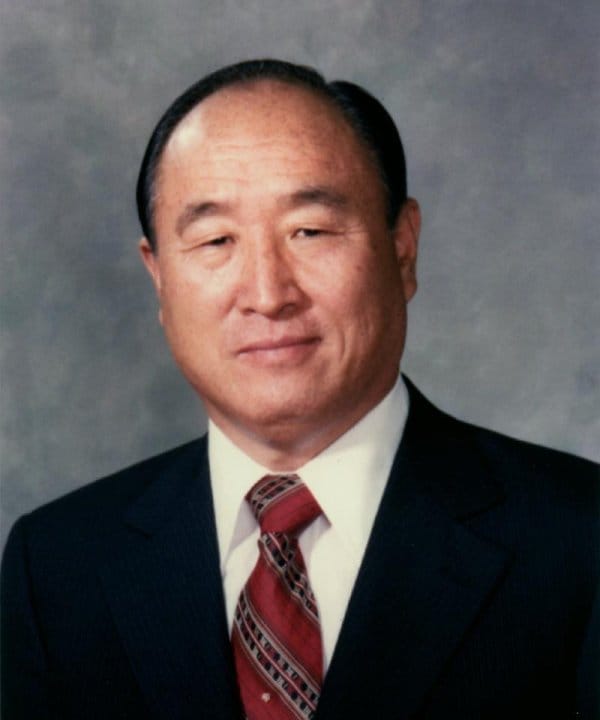
Sun Myung Moon
Founder of the Holy Spirit Association for the Unification of World Christianity
At a glance
Key facts
Sun Myung Moon (1920–2012) was a Korean religious leader who founded the Unification movement in 1954 and, together with Hak Ja Han Moon, is honoured within it as one of the True Parents. He taught the Divine Principle, established the Marriage Blessing, and built a network of religious, media and peace organizations now active in more than 190 nations. He was imprisoned six times in three countries and spoke publicly for more than five decades.
Full chronology in the timeline.
Legacy
Organizations founded by Rev. Moon
Did you know
Rev. Moon brought sushi to America
Did you know
The Reagan landslide prediction
Diplomacy
Meetings with heads of state
Persecution & faith
Six imprisonments in three countries
One of the most documented cases of repeated religious persecution in the 20th century.
Remarkable facts
Facts You Probably Didn't Know About Rev. Moon
Life milestones
From Jeongju to the world
"God is the original true parent of all humankind. He is the parent who has been longing for his lost children, shedding tears across thousands of years of history."
— Sun Myung Moon
Explore the archive
Teachings by theme
Rev. Sun Myung Moon
Questions & Answers
Key facts about the life, mission, teachings and legacy of the founder of the Unification Church.
The story of Rev. Moon and Ronald Reagan is one of the most striking examples of his real-world political influence. In 1980, Unification Church members actively supported the Reagan presidential campaign, and at Rev. Moon's direction, his close associate Col. Bo Hi Pak arranged a private meeting with Reagan in Toledo, Ohio. Greeting the candidate as "President Reagan" — before any polls suggested a landslide — Pak told him: "God has already decided on you as the next president." Reagan, taken aback, asked: "What did you say? Who on earth told you that?" When Pak explained Rev. Moon's prophetic confidence, Reagan replied with characteristic humor: "I wish I had as much confidence in myself as Rev. Moon does." Opinion polls at the time predicted a close race. But on Election Day 1980, Rev. Moon's New York newspaper, the News World, rolled off the press with a giant headline predicting a "Reagan Landslide" — hours before the results were in. Reagan did win in a landslide. Two years later, in 1982, Rev. Moon founded The Washington Times in Washington, D.C. Reagan quickly became one of its most devoted readers — insisting on reading it first thing every morning at the White House, ahead of the Washington Post. Pat Buchanan, White House communications director, confirmed that the Times was read by all senior staff before morning meetings, and that the president frequently made phone calls based on its stories. By 2002, Rev. Moon had invested roughly $1.7 billion in the paper, calling it "the instrument in spreading the truth about God to the world."
Rev. Moon consistently taught that "whoever is concerned about the future must look towards the ocean." This was not merely a metaphor — it was a practical, providential conviction rooted in his understanding of the world's most urgent problem: feeding humanity. He taught that the ocean surface is twice as large as all the land on earth, and that its resources, if properly developed with care and responsibility, could provide protein for billions of people who suffer from hunger. He envisioned a global network of fisheries, processing facilities, and distribution chains — not for profit, but as a solution to world poverty and the food crisis. Beyond the practical dimension, Rev. Moon taught that the ocean holds a deeper spiritual significance. He described it as both a classroom and a cathedral — a place where the human spirit is forged, where the smallness of the self confronts something vast, and where character is built through genuine hardship. He spent decades personally fishing in Gloucester, Massachusetts, in Alaska, in the Pantanal of Brazil, and in waters around the world — not as a hobby, but as a form of prayer, training, and providential preparation. He once declared himself "king of the ocean," not as a boast, but as a statement of mission: he believed the mastery of the sea was a key to mastering the future of human civilization. You can read his speeches on the ocean providence and his vision for the Pacific Rim era on tplegacy.net.
Rev. Moon's investment in the ocean industry was one of the most unusual and far-sighted aspects of his public work. Starting in the early 1970s, he began building fishing enterprises in the United States — including Master Marine, a shipbuilding and fishing company in Alabama, and International Seafood of Kodiak, Alaska. He designed the One Hope boat himself: a strong, fast, and beautiful vessel intended to attract young people to the ocean way of life. He invested in sushi restaurants, eventually owning more of them across the United States than any other single organization. He developed fish processing plants, fish farms, and distribution networks — all with a stated goal of solving world hunger through the ocean's protein resources. For Rev. Moon, fishing was never merely a business. He described it as the training ground for a new kind of human being — someone who could endure hardship, work for others, and confront the vastness of creation with humility. He also spent months fishing personally in the Pantanal region of Brazil, sharing his catch with local families and their children. His vision had two practical dimensions: providing food directly to the hungry and sharing technology and industry with developing nations so they could feed themselves sustainably. He saw the ocean as the great equalizer — a resource available to all humanity, one that required no territory and recognized no race or nationality.
Rev. Moon's vision of the ideal world — what he called Cheon Il Guk — was not a political utopia or a religious empire, but something far more personal: one family under God. He taught that God's original purpose in creating human beings was to experience joy through relating with ideal families filled with true love. The ideal world therefore begins not in institutions or governments, but in the family — where parents love children, children honor parents, husband and wife are united in God-centered love, and siblings care for one another. When this four-position foundation is realized in every family, it naturally extends to the tribe, the nation, and the world. In his landmark speech "God's Ideal Family and the Kingdom of the Peaceful, Ideal World", delivered at the founding of the Universal Peace Federation in 2005, Rev. Moon described this vision in detail: a world where all people recognize themselves as children of God, where national and racial barriers dissolve under the bond of a shared divine lineage, and where the principle of living for the sake of others governs every relationship. He taught that the ideal world is not created automatically or by wishing it into existence — it requires each person to perfect themselves through true love and to build God-centered families as the foundational unit of the Kingdom of Heaven on earth.
Rev. Moon identified several core values that must form the foundation of any truly peaceful world. The first and most fundamental is true love — defined not as a feeling but as a way of life: living for the sake of others before thinking of oneself. He taught that true love gives without expecting return, and the more it is invested, the more it grows. The second core value is true family — the God-centered family where all four directions of love (parent-child, husband-wife, sibling) are perfected. He taught that without the family as the school of love, no society or nation can achieve lasting peace. The third value is true lineage — the connection to God's original bloodline through the Marriage Blessing, which he viewed as the most essential act of restoration. The fourth is inter-religious and inter-racial harmony — the recognition that all human beings belong to one family under God, regardless of nationality, religion, or race. Rev. Moon consistently emphasized that a world of true peace requires all these values operating together. You can explore his most comprehensive articulation of these principles in the Messages of Peace and in the Cheon Seong Gyeong on tplegacy.net.
Rev. Moon taught that virtually every problem facing humanity — war, poverty, racial conflict, family breakdown, environmental destruction — has a single root cause: selfish love. When people live only for themselves, they naturally come into conflict with others. Nations compete rather than cooperate. Religions fight rather than unite. Families disintegrate rather than grow. The solution, he taught, is not a new political system or a better economic model, but a fundamental revolution in the orientation of the human heart: from living for oneself to living for the sake of others. He taught this not as an abstract ideal but as a practical principle with observable consequences. A person who truly lives for others, he said, cannot be invaded by evil — because there is nothing in such a person for self-interest or resentment to attach to. When this principle scales from the individual to the family, tribe, nation, and world, the result is what Rev. Moon described as the Kingdom of Heaven on earth. He also demonstrated this with his life: sharing food with weaker prisoners in the Hungnam labor camp, forgiving those who persecuted him, embracing his former enemy Kim Il-sung. His prayers for the philosophy of peace and his major Messages of Peace on tplegacy.net develop this theme in depth.
Rev. Moon's international influence extended far beyond his religious movement. He met privately with Soviet President Mikhail Gorbachev in Moscow in April 1990, urging him to allow religious freedom and open the Soviet Union to the world. Gorbachev followed both pieces of advice. He met North Korean leader Kim Il-sung in December 1991 — near the site of the Hungnam labor camp where he had been a prisoner four decades earlier — and embraced him like a brother, later calling it the hardest thing he had ever done. He addressed the United Nations and held summits attended by hundreds of current and former heads of state from around the world. Beyond diplomacy, Rev. Moon built one of the most significant global media empires ever created by a religious figure: The Washington Times (1982), newspapers in South Korea, Japan, Uruguay, and the Middle East, and in 2000 the acquisition of United Press International. In 2005 he co-founded the Universal Peace Federation, an NGO in special consultative status with the United Nations, active in 185 nations. He also brokered Israeli-Palestinian dialogues between Knesset and Palestinian Parliament members, and organized mass Blessing ceremonies uniting couples across racial, national, and religious divides. A full record is available on the True Parents Timeline and the summits archive on tplegacy.net.
Rev. Moon was imprisoned six times across three countries — North Korea, South Korea, and the United States — making his personal history one of the most documented cases of repeated religious persecution in the 20th century. The most severe was his imprisonment in North Korea: arrested in Pyongyang on February 22, 1948, accused of being a South Korean spy, he was tortured and sentenced to five years of hard labor at the Hungnam forced labor camp — one of the most brutal in the country, where prisoners produced nitrogen fertilizer under extreme conditions and many died from exhaustion and malnutrition. In the camp, Rev. Moon consistently took on the most difficult tasks and gave portions of his own food to weaker prisoners. He described this period as one when he could most clearly hear God's voice. He was liberated on October 14, 1950, when UN forces reached the Hungnam area, and made his way south as a refugee — carrying a fellow prisoner on his bicycle, eventually reaching Busan. His third imprisonment was in South Korea in 1955 on charges later proven groundless; he was acquitted after three months. In 1984, he was convicted in the United States on tax charges and served 13 months in Danbury Federal Prison — a case forty leading religious and civil liberties organizations contested as unjust. He entered prison calmly, with a smile, holding his wife's hand.
According to his own testimony, Rev. Moon received a divine revelation on Easter morning when he was sixteen years old. Jesus Christ appeared to him and asked him to continue the work that Jesus had been unable to complete. From that moment, Rev. Moon entered into years of intense prayer, spiritual struggle, and study of the Bible, seeking to understand the deepest mysteries of God's will. He describes this period as a time of fighting alone against millions of devils in both the spiritual and physical worlds. His public mission formally began in 1945, following Korea's liberation from Japanese colonial rule. In the late spring of 1946, he received the divine command to cross the 38th Parallel and begin his work in North Korea — entering what he described as Satan's headquarters — leaving behind his newborn son and family to follow God's direction alone.
Rev. Sun Myung Moon was born on January 6, 1920, in Jeongju, in what is now North Korea, in a rural farming family. He grew up in a village environment, spending his childhood observing nature, climbing trees, and developing an extraordinary sensitivity to the world around him. From an early age he was known for his refusal to accept defeat — he later described himself as someone who "absolutely hates losing." His family converted to Christianity when he was around ten years old, and from that point his deep spiritual sensitivity began to express itself through prayer and reflection. He moved to Seoul as a teenager to attend school, investigating the lives of the poor in back alleys, and quietly developing the inner life that would later define his mission. During his time in Japan, where he studied electrical engineering at Waseda University in Tokyo, he worked in iron foundries and dockyards in Kawasaki — while also engaging in underground Korean independence activities against Japanese colonial rule.
The Holy Spirit Association for the Unification of World Christianity (HSA-UWC) was officially founded on May 1, 1954, in a tiny rented house in northern Seoul — a house so small that when Rev. Moon lay down, his feet touched the walls. He had no money, wore faded army work jeans and rubber shoes, and sometimes went without adequate food. He described the founding not as an act of personal ambition but as a response to a divine command. Within a year, the church had attracted professors from Ewha Women's University and Yonsei University — and the rapid growth provoked fierce opposition from established Christian churches and the government, leading to his 1955 arrest. You can follow the full history through the True Parents Timeline on tplegacy.net and in Rev. Moon's life in his own words.
In 1982, Rev. Moon founded The Washington Times — a daily newspaper in the United States capital — describing it not as a business venture but as a providential act: the United States, which he viewed as central to God's providence, needed a voice that could counter materialism and the spread of godless ideology. He concluded that the lack of a strong second newspaper in Washington would jeopardize efforts to roll back Soviet communism. The paper became influential during the Reagan administration and was regularly read at the White House. Beyond this, Rev. Moon established newspapers in South Korea, Japan, Uruguay, Argentina, and other countries, and built one of the most significant global media operations ever founded by a religious leader. He also met privately with Soviet President Mikhail Gorbachev in April 1990, urging him to allow religious freedom in the Soviet Union — advice Gorbachev followed. A full overview of these milestones is available on the True Parents Timeline.
Rev. Moon's opposition to communism was rooted not in politics but in theology — having survived imprisonment and torture at the hands of a communist regime, he taught that communism should be defeated not through military force, but ideologically through what he called Godism. The fundamental issue, as he expressed it, was "God or no God." In the early 1960s he formalized a comprehensive analysis of Marxist-Leninist ideology known as Victory Over Communism Theory (VOC), and in 1968 founded the International Federation for Victory Over Communism. As early as 1972, he declared that communism would begin to decline around 1977 and be thoroughly discredited within a decade — an idea that seemed unbelievable at the time, but the Berlin Wall fell in 1989. Crucially, Rev. Moon always distinguished between the communist system and the people living under it, describing his ideology as the salvation of all humankind — including communists. After the fall of the Soviet Union, he invested heavily in economic development in China and North Korea and brought thousands of people from former Soviet bloc countries to the United States and Japan for education in a new value system.
Throughout his life, Rev. Moon consistently refused to respond to persecution with hatred or a desire for revenge. When imprisoned in Seodaemun Prison in 1955 — on charges that were ultimately proven groundless — he did not wish for Korea or the Christian churches that had opposed him to perish. Instead he prayed: "Please allow me to shoulder all the sins committed by Korea, this poor nation, that I may indemnify them." When Christian ministers testified against him in court in Pyongyang, he did not condemn them but understood their actions as reflecting ignorance. His response to opponents was consistently: "Wait and see." He taught that bad things go to ruin and good things thrive — and that no matter how corrupt the environment, a person walking in truth cannot ultimately be destroyed. You can read his prayers for the heart and his own words on endurance and forgiveness on tplegacy.net.
Rev. Moon consistently taught a theology of suffering as indemnity — the idea that sin and failure in history must be compensated through conditions of sacrifice before restoration can occur. He taught that his imprisonments, torture, poverty, and persecution were necessary indemnity conditions he was paying on behalf of humanity and God, on behalf of the failures of all the biblical figures who had gone before him. Even during torture in Pyongyang — when he was beaten until he vomited blood and repeatedly lost consciousness — he never asked God to help him escape, but instead comforted God, saying "Father, don't worry. I'm not dead yet." He described the scars on his body from this period as medals given to him by heaven and humanity. This orientation — toward suffering with love and forgiveness rather than bitterness — is central to understanding the entire Unification movement. Read more in his life in his own words and in his prayers for determination.
Several historical records and milestones are associated with Rev. Moon's ministry. The Blessing ceremony grew from 3 couples in 1960 to 36 couples (1961), 777 couples (1970), 1,800 couples (1975), 30,000 couples (1992), 360,000 couples (1995), and ultimately ceremonies claiming millions of participating couples across the globe simultaneously. His sermons, collected in The Sermons of Rev. Sun Myung Moon, reportedly run to over 600 volumes in the Korean edition — one of the largest bodies of religious speech by a single individual in modern history. He founded the Unification Church (1954), The Washington Times (1982), the Family Federation for World Peace and Unification (1996), the Universal Peace Federation (2005), and Foundation Day (2013). A complete chronological overview is available on the True Parents Timeline. He passed away on September 3, 2012, at the age of 92 in Cheongpyeong, South Korea.
Rev. Moon's vision of world peace was inseparable from his theology: true peace, he taught, cannot be achieved through politics, economics, or military power alone — it can only be achieved through God-centered families. His pursuit of this vision was expressed through an extraordinary range of global initiatives: he founded the Unification Church (1954), the International Federation for Victory Over Communism, The Washington Times newspaper (1982), the Inter-Religious Federation for World Peace, the Women's Federation for World Peace, and ultimately the Family Federation for World Peace and Unification (1996). He organized mass Blessing ceremonies uniting couples from dozens of nations across racial and religious boundaries, and co-founded the Universal Peace Federation in 2005. Rev. Moon described the goal of all this work as the establishment of Cheon Il Guk — the Kingdom of Heaven on earth — a world where all people live as one family under God. Read his prayers for the philosophy of peace and his major peace speeches on tplegacy.net.
Rev. Moon's understanding of God is one of the most distinctive contributions of his teaching. He consistently described God not as a remote, omnipotent ruler but as a Parent — a being of profound heart, whose most fundamental desire is to love and be loved by His children. He taught that God has been the most sorrowful being in the universe since the Fall — longing for His children across millennia, unable to embrace them because of the condition of sin. This understanding permeates his prayers about God, his sermons, and the opening books of the Cheon Seong Gyeong. Rev. Moon taught that God has dual characteristics — internal nature and external form, masculine and feminine — and that human beings, created as God's object partners of love, were meant to be the living embodiment of God's heart. The liberation of God from His historical sorrow — achieved through the restoration of true families — was, in Rev. Moon's teaching, the ultimate goal of all human history.
True love is perhaps the most central theme in all of Rev. Moon's teaching. He defined true love not as a feeling or an emotion, but as a principle of existence: to live for the sake of others. He taught that God is the origin of true love — that God created human beings in order to experience love through them, and that the universe exists as a vast system of giving and receiving centered on love. True love, in his teaching, flows in four directions: from children to parents, from parents to children, between husband and wife, and between siblings — and when all four directions are realized in a God-centered family, that family becomes the foundation of the Kingdom of Heaven. Rev. Moon taught that a person who truly lives for the sake of others cannot be invaded by evil — because true love is the one force that Satan cannot accuse or oppose. This theme runs through his sermons, his prayers, and every book of the Cheon Seong Gyeong.
✦ Spiritual Messages: Rev. Sun Myung Moon ✦ — page 22